
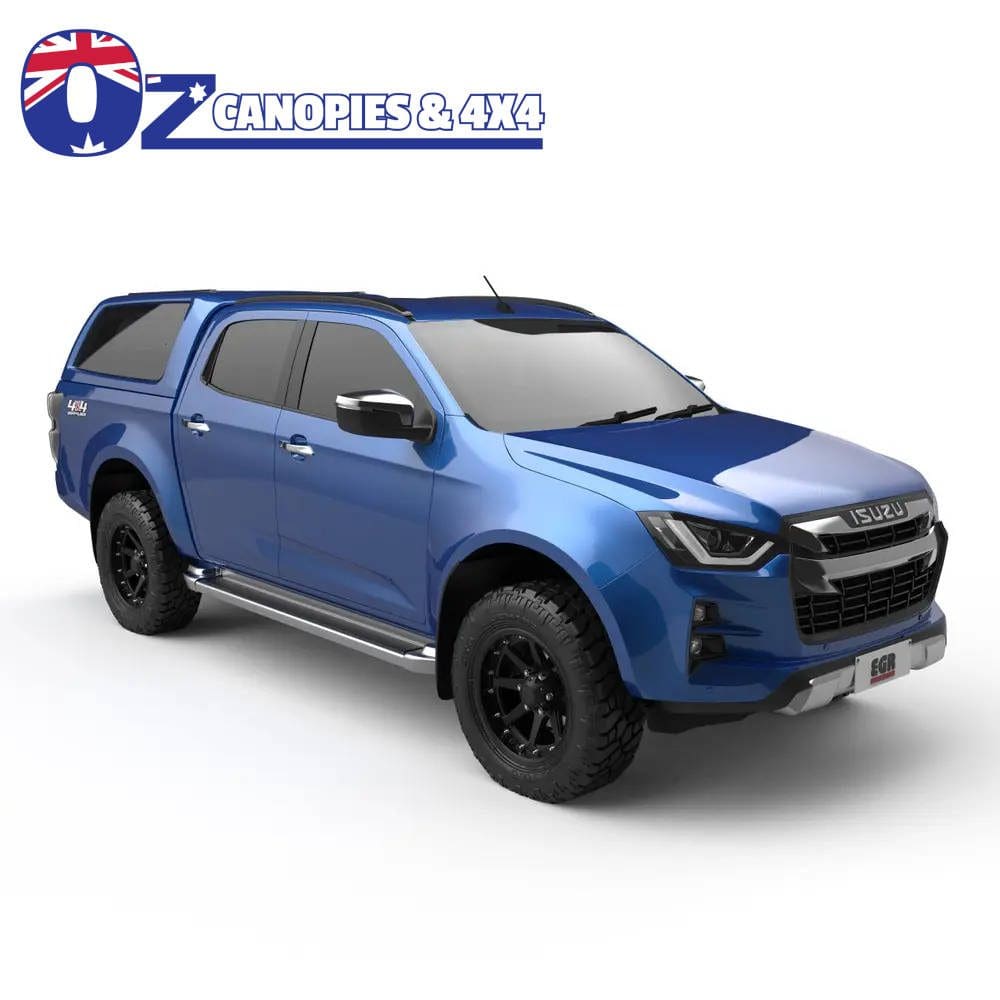
Isuzu D-MAX Canopy Guide: Best Canopy Setups for Touring, Trade and Everyday Use
The Isuzu D-MAX has earned its reputation as one of Australia’s most dependable ute platforms. Whether you are a tradie running between sites, a tourer heading bush for the long weekend, a caravan owner setting up a reliable tow vehicle or just someone who needs a practical dual cab that does the lot, the D-MAX keeps showing up on driveways for good reason.
But here is what most new D-MAX owners figure out pretty quickly. The open tub is fine for picking up a few bags of mulch or chucking the camping chairs in the back. The moment you start loading tools, a fridge, recovery gear, camping equipment, dog crates or anything you actually want to keep dry and secure, the factory tub runs out of answers fast.
That is where a proper canopy setup changes everything.
A canopy is not just a lid on the back of the ute. It is the foundation of your entire build. Get it right and you get lockable weatherproof storage, better internal organisation, proper accessory mounting and a vehicle that actually suits the way you use it. Get it wrong and you waste payload on the wrong material, buy accessories in the wrong order or end up with a setup that does not fit the D-MAX tub properly.
This guide is built for Australian D-MAX owners. Tradies, tourers, caravan owners, campers, dog owners, families, fleet managers and anyone in between. We will walk through canopy types, materials, use case setups, payload considerations, towing impacts, accessories, fitment traps, pricing and common mistakes, so you can build your D-MAX the right way from day one.
Quick answer: what is the best canopy for an Isuzu D-MAX?
For most D-MAX owners, a lightweight aluminium canopy is the strongest all round choice. It gives you secure storage, weather protection, accessory mounting flexibility and usable internal space without chewing through payload the way heavier materials can. Fibreglass canopies suit lifestyle buyers who want a factory matched look, while full tray and canopy setups suit serious touring, trade and heavy duty builds.
Why the Isuzu D-MAX Is a Strong Platform for a Canopy Setup
Not every ute suits every canopy build equally. The D-MAX works well because the people buying them tend to be practical. They want a vehicle that handles work, towing, touring or a mix of all three without needing constant attention.
The D-MAX buyer is usually practical, not cosmetic
You do not see many D-MAX owners chasing chrome mirror caps or neon underglow. The typical D-MAX buyer is a tradie who needs a reliable work vehicle, a tourer planning lap trips, a caravan owner who wants solid towing numbers or a regional driver who needs something tough enough for gravel roads and long hauls. Families running a D-MAX as a dual purpose work and weekend vehicle are a growing segment too.
The D-MAX’s 3.0 litre turbo diesel (and the newer 2.2 litre option introduced for the 25.5MY update) both deliver 3,500 kg braked towing capacity across the range. The current D-MAX holds a five star ANCAP safety rating, which matters when you are building a vehicle that will carry your family, your tools or your dog through everything from school drop offs to outback highways. Isuzu’s reputation for mechanical reliability, the six year/150,000 km warranty and strong resale values all make it a sensible platform to invest in a proper canopy build.
Regional and rural D-MAX owners are a big part of the market too. If you are running a property, driving long distances on unsealed roads or using the ute as your only vehicle for work and personal use, a canopy is not a luxury. It is essential infrastructure for keeping your gear dry, secure and organised in conditions that chew through anything left exposed in an open tub.
Why the factory tub often needs upgrading
The D-MAX tub is decent, but it has the same limits as every other open ute tub. An open tub means your gear is exposed to rain, dust, sun and anyone walking past. A soft tonneau cover keeps the weather off but does nothing for security or vertical storage. Roller shutters look tidy but cut your usable height in half. Hard lids give you a flat surface on top but restrict how much you can actually load inside. For a head to head comparison of all three tub cover options, see our D-MAX canopy vs hard lid vs roller shutter guide covering storage, security, roof racks and which suits each use case.
If you are carrying power tools, a fridge, camping gear, dog crates or recovery equipment, you need lockable vertical storage with proper internal layout options. That means a canopy.
Why a canopy changes how the D-MAX can be used
Once a canopy goes on, the D-MAX becomes a different vehicle. You get weatherproof lockable storage. You get the height to stack gear, install drawers, run a fridge slide and still have room to move. You get mounting points for roof racks, awnings and lighting. You get dust sealing for gravel roads. You get a proper touring, trade or camping platform instead of an open tub that you are constantly trying to cover up.
For dog owners, a canopy with ventilation and shade is a safer way to travel with pets than leaving them in an open tub exposed to sun, wind and road debris. For tradies, a canopy turns the ute into a mobile workshop with lockable side access and internal shelving.
Isuzu D-MAX Canopy Compatibility: What You Need to Know Before Choosing
Before you start comparing materials, window styles or drawer systems, you need to sort out fitment. This is where a lot of D-MAX buyers go wrong, especially when shopping online or looking at second hand options.
Does every canopy fit every D-MAX?
No. Canopy fitment depends on body style, tub dimensions and model generation. A canopy designed for a crew cab ute tub will not fit a space cab or a single cab chassis. A tub canopy is not the same as a tray canopy. Even within the crew cab range, differences between model years can affect how a canopy sits, seals and integrates with things like the reversing camera, sports bar mounting points or central locking wiring.
Common mistake: Buying a canopy online because it says “D-MAX” in the listing without confirming body style, model year and whether it is a tub or tray canopy. This is especially risky with second hand purchases.
D-MAX body styles and canopy fitment
The current D-MAX range includes several body configurations:
- Crew Cab Ute (dual cab with factory tub). This is the most common configuration for retail canopy buyers. Tub canopies mount directly onto the existing tub.
- Crew Cab Chassis. No factory tub. Requires a tray and canopy combination or a full cab chassis canopy body.
- Space Cab Chassis. Smaller cab, longer tray area. Different tray dimensions to crew cab.
- Single Cab Chassis. Work focused. Longest available tray space.
- 4×2 High Ride and 4×4 models. Both available across multiple body styles. GVM and payload differ between 4×2 and 4×4 variants.
Most D-MAX canopy buyers looking at retail canopies will be shopping for a crew cab ute fitment. But if you are a tradie or fleet buyer running a cab chassis, the tray and canopy setup gives you more modular options. For a detailed breakdown of which canopies fit which D-MAX models by year, body style and tub configuration, see our D-MAX canopy fitment guide covering model years, body styles and compatibility.
D-MAX tub dimensions and why they matter
The crew cab D-MAX tub has a floor length of roughly 1,570 mm, a maximum width of around 1,530 mm, a width between the wheel houses of approximately 1,122 mm and a depth of about 490 mm. These measurements matter because every component you put inside the canopy needs to work within them.
Drawer systems have to clear the wheel arches. Fridge slides need enough depth to operate without hanging over the tailgate. Roof racks need a canopy structure rated for the intended load. Tub liners can add a few millimetres that change how the canopy base sits and clamps down. Even the tailgate seal gap can affect dust and water resistance depending on how the canopy is mounted.
If you are planning drawers, check that the internal width between the wheel arches gives you enough room for the drawer unit you want. Some full width drawer systems need the entire 1,122 mm between wheel houses and will not fit if a thick tub liner is already in place. This is one of the most common fitment issues we see. Someone buys a great drawer system, gets it home and realises it does not clear the wheel arches with the existing tub liner.
For fridge slide setups, the 1,570 mm floor length in the crew cab tub means your fridge needs to fit within the available depth once drawers or a false floor are in place. Measure twice, buy once. And if you are running a drop down fridge slide, make sure you have enough clearance behind the tailgate when it is open.
Tub liner tip: If you already have a tub liner fitted and you are planning a canopy, bring the tub liner details (brand, thickness, whether it has raised edges) to the canopy supplier. It affects how the canopy base sits and whether the clamps will seal properly.
Older D-MAX vs current D-MAX canopy fitment
The current third generation D-MAX (launched in 2020, facelifted in 2024) has different tub dimensions to the previous generation. A canopy built for a 2015 D-MAX will not necessarily fit a 2024 model. The tub shape, mounting points, tailgate profile and even the position of the reversing camera and wiring harness have changed between generations.
The third generation D-MAX also introduced the Intelligent Driver Assistance System (IDAS), which includes features like adaptive cruise control, autonomous emergency braking and lane departure warning. While most of these are not directly affected by a canopy, some canopy installations can interfere with rear sensors or cameras if not fitted correctly. Make sure your canopy supplier knows your exact model year and trim level so they can account for sensor and camera positioning.
If you are looking at second hand canopies, confirm the exact model year, body style and tub configuration before handing over any money. Things to watch for on a used canopy include wrong tub shape, missing or worn clamps, damaged seals, incorrect rear window alignment and central locking wiring that does not match your vehicle.
A used canopy from the same generation D-MAX can work, but you still need to check seal condition, window strut strength, any signs of impact damage and whether the clamps are all present and functioning. Replacement seals and struts are usually available, but factor the cost into your purchase price.
Common mistake: Assuming a “D-MAX canopy for sale” listing on Facebook Marketplace automatically fits your model. Always check generation and body style first. A cheap canopy that does not seal properly is worse than no canopy at all.
Best Canopy Types for an Isuzu D-MAX
This is the section where most buyers spend most of their research time. The three main canopy materials are aluminium, fibreglass and steel. Each has a job it does well and a job it does poorly.
Aluminium canopy for Isuzu D-MAX
For most D-MAX owners, aluminium is the strongest all round option. It is lighter than steel (a well designed aluminium canopy typically sits around 70 to 100 kg depending on size, windows and features), strong enough for touring and trade use and highly practical for mounting accessories like roof racks, awnings, drawers and lighting systems.
Aluminium resists corrosion well, holds up under Australian conditions and suits the kind of practical, build it right once approach that most D-MAX owners take. For how aluminium and fibreglass compare head to head on weight, strength, roof load and accessory mounting for the D-MAX, see our guide covering which material suits each buyer type.
Best suited to: Touring builds, trade setups, camping rigs, mixed work and family use and any buyer who cares about managing payload.
Aluminium canopies also tend to offer the most flexibility for aftermarket accessories. If you plan to add a roof platform, awning brackets, internal lighting or side access tool storage, aluminium gives you more options than most fibreglass designs.
Fibreglass canopy for Isuzu D-MAX
Fibreglass canopies are the go to for buyers who want a smooth, colour matched OEM look. A well made fibreglass canopy can look like it rolled off the factory floor, which matters to some D-MAX owners who use the ute as a daily driver and want it to look clean.
Fibreglass can work well for light duty storage, family weekends and urban driving. But it is generally less versatile than aluminium when it comes to mounting heavy accessories, running internal fitouts or handling the kind of abuse that touring and trade setups demand.
Best suited to: Families, weekend use, light camping, urban daily drivers who prioritise appearance.
Honest take: If you want the D-MAX to look like it came with a canopy from the factory, fibreglass will do that better than anything else. But if you want to load it up with roof racks, tool storage, drawers, awnings and touring accessories, aluminium usually makes more practical sense.
Steel canopy for Isuzu D-MAX
Steel is the heavy duty option. It is strong, impact resistant and suits harsh trade and fleet environments. If you work in mining, construction or any setting where the canopy takes regular hits, steel can handle it.
The trade off is weight. A steel canopy is noticeably heavier than aluminium and on a D-MAX where payload management matters, that extra weight comes directly out of what you can legally carry.
Best suited to: Heavy trade, mining and fleet use, industrial environments and buyers who neeD-MAXimum impact resistance.
Common mistake: Assuming steel is automatically “better” because it is stronger. If your setup includes drawers, a fridge, water tank, rooftop tent, bull bar, towbar, passengers and tools, a heavy steel canopy can push you close to or over your GVM before you have even loaded the ute.
Tub canopy vs tray canopy for D-MAX
A tub canopy mounts directly onto the factory D-MAX tub. It is the simpler, more affordable starting point for most dual cab owners. It keeps the factory tub, gives you a cleaner overall look and suits everyday, touring and light trade setups well.
A tray canopy replaces the factory tub entirely with a custom tray and canopy combination. This gives you a more modular layout, better flexibility for trade bodies and more storage options. But it is more expensive, usually heavier and involves a bigger build.
For most D-MAX crew cab owners, a tub canopy is the right starting point. If you are a serious tradie, fleet operator or long range tourer who needs a fully modular setup, a tray and canopy package may be worth the investment.
Isuzu D-MAX Canopy Setup by Use Case
The best canopy setup depends entirely on how you use the ute. A tradie running between job sites has completely different priorities to a family heading to a national park for the weekend. This section breaks it down by use case so you can find the setup that actually fits your life.
Best D-MAX canopy setup for everyday use
If you are using the D-MAX as a daily driver and just want secure, weatherproof storage without turning it into a full overland rig, keep it simple.
Recommended setup:
- Aluminium or fibreglass canopy
- Lift up or sliding side windows
- Basic internal LED lighting
- Rubber mat or tub liner
- Central locking if available
- Roof racks only if you actually need them
- Skip the heavy drawer system unless you have a reason for it
The goal here is security and weather protection without adding unnecessary weight. A basic canopy with good locks and decent seals is all most daily drivers need. You can always add accessories later.
Best D-MAX canopy setup for touring
Touring builds are where D-MAX canopy setups get serious. If you are planning long weekends, national park trips, remote travel or using the D-MAX as a caravan support vehicle, the canopy becomes the backbone of your entire setup.
Recommended setup:
- Aluminium canopy (lightweight is critical here)
- Canopy mounted roof racks or platform
- 270 degree awning
- Drawer system
- Fridge slide
- Internal LED lights
- 12V power system with auxiliary battery and DC DC charger
- Dust sealing
- Recovery gear storage
- Water storage option
- Ventilation for airflow
- Optional rooftop tent if canopy and rack system are weight rated for it
The key to a good touring build is designing the internal layout before buying any accessories. Start by deciding where the fridge goes, because that usually dictates the drawer layout. Then work out recovery gear storage, water placement and electrical routing. The worst touring builds are the ones where someone bought everything separately, tried to make it all fit at the same time and ended up with a canopy full of gear that does not work together.
Water storage is a big consideration for remote touring. You can mount jerry cans inside the canopy, fit an under tray water tank or use collapsible bladders. Each option has weight and space trade offs. Jerry cans are flexible and removable. Under tray tanks keep weight low but add to the vehicle permanently. Bladders fold flat when empty but can be harder to fill.
Dust sealing is non negotiable for any D-MAX that regularly sees gravel roads. Positive pressure vent systems are the gold standard. They push filtered air into the canopy, which creates slight positive pressure that stops dust from getting sucked in through gaps. Without this, even a well sealed canopy will accumulate dust on long unsealed road trips.
Common mistake: Building a touring setup by buying accessories one at a time without thinking about total weight. Start with the canopy, then design the internal layout around your heaviest items. Know your payload budget before you start bolting things on. For a step by step guide to building a D-MAX touring canopy setup with the right accessory sequence and weight management, see our D-MAX touring canopy setup guide covering drawers, fridge, 12V, dust sealing and build order.
Best D-MAX canopy setup for tradies
Trade setups are about efficiency. You need to get to tools quickly, keep expensive equipment secure and have a canopy that handles daily abuse without falling apart.
Recommended setup:
- Aluminium or steel canopy depending on how rough the work environment is
- Lift up side access panels (side access matters more than rear access for most trades)
- Internal shelving
- Tool drawers with dividers
- Ladder racks if required
- Roof bars for long materials
- Internal LED work lighting
- Central locking and window security
- Weather sealing
- Tie down points for loose equipment
Trade specific tip: Internal organisation saves more time over a week than most tradies realise. If you are digging through a messy canopy for ten minutes every morning looking for the right fitting or bracket, drawer dividers and shelf labels pay for themselves fast. For a trade specific guide covering how to set up a D-MAX canopy around tool access, drawers, ladder racks and security for different trades, see our D-MAX trade canopy setup guide covering electrician, plumber, builder and mobile service layouts.
Best D-MAX canopy setup for towing and caravan travel
This is a big one. The D-MAX offers up to 3,500 kg braked towing capacity when fitted with a genuine Isuzu tow bar and electronic brake controller. But towing capacity is only part of the picture. Once you add the canopy, passengers, gear, fuel, water and tow ball download to the equation, available payload can shrink faster than you expect.
Recommended setup:
- Lightweight aluminium canopy (every kilo matters when towing)
- Minimal roof load (keep heavy items low)
- Lower mounted drawers for a lower centre of gravity
- Heavy items forward in the canopy where practical
- Internal tie downs for everything
- 12V power for fridge and caravan support
- Towbar with correct rating
- Electric brake controller
- Towing mirrors for wider caravans
- Weight distribution hitch where suitable for the trailer type
When towing, every decision about canopy accessories should be filtered through one question: does this add weight that makes towing less safe or less legal? A lightweight aluminium canopy with a simple drawer system and a fridge is a very different towing proposition to a steel canopy with a full platform roof rack, rooftop tent, 270 degree awning and long range water tank.
For caravan owners, the tow ball download deserves special attention. A large caravan might put 300 to 350 kg of vertical force on the tow ball. That 350 kg counts directly against your D-MAX’s available payload. If the vehicle is already loaded with a canopy, drawers, fridge, passengers, fuel and gear, there may not be 350 kg of payload left for the ball weight. This is where GVM and GCM calculations become critical.
A weight distribution hitch can help improve handling and weight transfer for larger trailers, but it does not change the GVM or GCM limits. It redistributes the load across the axles, not add capacity. If you are running a heavy caravan setup, talk to a qualified towing specialist about whether a weight distribution hitch is appropriate for your combination.
Common mistake: Loading all the heavy gear at the back of the canopy right above the rear axle while also running a heavy tow ball download. This shifts too much weight behind the rear axle and can affect steering, braking and handling. Spread weight forward where possible.
Tow ball download counts against your available payload. A large caravan with a 350 kg ball weight leaves a lot less room for tools, water, passengers and accessories than most people expect. For a detailed breakdown of how payload, GCM, ball weight and rear axle load interact when towing with a D-MAX canopy, see our Isuzu D-MAX towing with canopy guide covering specs, weight stacking and setup tips by towing type.
Best D-MAX canopy setup for dogs
Dog owners travelling with pets in the canopy area need to think about ventilation, temperature, shade, security and comfort. A sealed canopy without airflow can get dangerously hot, even on a mild day.
Recommended setup:
- Canopy with good ventilation (sliding windows, mesh panels or pop out vents)
- Shade inside the canopy
- Secure crate or barrier
- Non slip flooring or matting
- Tie down points for crate
- Water bowl and storage
- Avoid solid panel canopies with no airflow options
State and territory laws around transporting animals vary across Australia. In New South Wales, the Prevention of Cruelty to Animals Act requires that animals must be transported in a way that does not cause unreasonable pain or suffering. In Queensland, dogs in an open tub must be restrained so they cannot fall from the vehicle. Victoria’s Prevention of Cruelty to Animals Regulations have similar provisions around securing animals during transport. Check the specific rules in your state before setting up the canopy for dog travel, as fines and penalties differ between jurisdictions.
Common mistake: Fitting a canopy with fixed glass windows and no ventilation options, then wondering why the dog is overheating on a 28 degree day. Sliding windows or mesh panels are essential for any canopy that regularly carries dogs. For a full guide to setting up a D-MAX canopy for safe dog transport with the right ventilation, restraint and heat management, see our D-MAX canopy for dogs guide covering airflow, crate setup, state laws and trip type setups.
Best D-MAX canopy setup for camping
Camping setups overlap with touring, but the key difference is that a camping build is often lighter and less permanent. If you only camp a few times a year, you probably do not need a full overland rig.
Recommended setup:
- Aluminium canopy
- Drawer system for kitchen and camp gear
- Fridge slide
- 270 degree or 180 degree awning
- Roof racks for recovery boards, swag or solar panel
- Internal LED camp lighting
- 12V power for fridge and phone charging
- Recovery boards if heading off road
Honest take: Do not turn a weekend camping D-MAX into a 3 tonne touring machine if you only camp four times a year. Keep it light, keep it removable where possible and spend the money on the gear you will actually use. For a detailed camping specific guide ranging from simple weekend setups to remote off grid trips, see our D-MAX camping canopy setup guide covering fridge, drawers, awnings, lighting, water and trip type layouts.
Payload, GVM and Towing: What D-MAX Canopy Buyers Need to Understand
This section is not the most exciting part of choosing a canopy, but it might be the most important. Get your weight management wrong and you risk being over GVM, which means you are driving illegally, your insurance could be void and your vehicle handling may be compromised.
Why canopy weight matters on a D-MAX
Every kilogram of canopy, drawers, roof rack, fridge, water, tools and accessories comes directly out of your available payload. Payload is your GVM minus your kerb weight. Once you add passengers, fuel, tow ball download and cargo, the maths can get tight.
Here is a sample weight stack to show how quickly it adds up. These are examples, not fixed specs, because every build is different.
| Item | Approximate weight range |
| Aluminium canopy | 70 to 100 kg |
| Drawer system | 60 to 120 kg |
| Fridge and slide | 35 to 70 kg |
| Roof racks or platform | 25 to 60 kg |
| Awning | 20 to 35 kg |
| Tools, recovery and camping gear | 100 to 250 kg |
| Passengers (2 to 4 people) | 150 to 300 kg |
| Tow ball download | Up to 350 kg depending on trailer |
Add those up and a moderate touring build with two passengers, a fridge, drawers, roof racks, an awning and basic camping gear can easily account for 500 to 800 kg or more, before you even hook up a trailer.
D-MAX payload by variant
Payload varies depending on which D-MAX variant you have. The official spec sheets list payload from around 930 kg to roughly 1,350 kg depending on model, engine, body style and drivetrain.
| D-MAX variant type | GVM | Approximate payload range |
| 4×2 High Ride | 3,000 kg | Approx. 1,175 to 1,350 kg depending on variant |
| 4×4 | 3,100 kg | Approx. 930 to 1,310 kg depending on variant |
Cab chassis variants have a different final mass depending on the tray or body fitted, so payload calculations for cab chassis builds require knowing the weight of the tray and canopy package as well.
Common mistake: Assuming all D-MAX variants have the same payload. A fully loaded 4×4 crew cab with a 3.0 litre engine and all the options has a different kerb weight (and therefore different payload) to a base 4×2 single cab.
Does a D-MAX canopy affect towing?
Yes, indirectly. A canopy does not reduce the D-MAX’s advertised 3,500 kg braked towing capacity by itself. But it does use payload. And once you factor in the canopy, passengers, fuel, accessories, tools and tow ball download, the amount of weight you can legally carry while towing drops.
Here is how the key terms work:
- GVM (Gross Vehicle Mass): The maximum total weight of the vehicle plus everything in and on it. D-MAX 4×4 variants sit at 3,100 kg.
- GCM (Gross Combination Mass): The maximum combined weight of the vehicle plus the trailer. D-MAX figures range from 5,850 kg to 6,000 kg depending on variant.
- Kerb weight: The weight of the vehicle with standard equipment and a full tank of fuel, but no passengers, cargo or accessories.
- Payload: GVM minus kerb weight. This is your budget for everything you add.
- Tow ball download: The vertical weight the trailer pushes down on the tow ball. This counts against payload.
- Braked towing capacity: The maximum weight of a trailer with its own braking system. D-MAX is rated at 3,500 kg across the range.
The GCM figure is the one that catches people out. If your D-MAX is at GVM and your trailer is at its maximum, the combined weight might exceed GCM even though each individual limit looks fine on paper.
When should D-MAX owners consider a GVM upgrade?
If your build includes a heavy canopy, full drawer system, rooftop tent, long range fuel or water storage, bull bar, winch, rear bar and you plan to tow regularly or carry a full trade load, you may be running close to or over the factory GVM.
A GVM upgrade increases the legal maximum weight the vehicle can carry. These upgrades are available through approved engineering companies and typically involve suspension upgrades, compliance testing and re plating the vehicle. The upgrade needs to account for braking capacity, suspension performance, tyre ratings and structural integrity across the full range of upgraded weights.
Vehicle modifications in Australia should be considered against VSB 14, the National Code of Practice for Light Vehicle Construction and Modification, published by the Department of Infrastructure, Transport, Regional Development, Communications and the Arts. VSB 14 sets out the technical requirements for modifications, while state and territory registration authorities handle the administrative side. Australian Design Rules (ADRs), administered by the same department, set the baseline safety and emissions standards that all road vehicles must comply with. A GVM upgrade must work within these frameworks.
In Victoria, modifications like GVM upgrades typically need certification through the Vehicle Assessment Signatory Scheme (VASS), which confirms the work has been completed in accordance with VSB 14. Other states have their own processes. In New South Wales, the relevant authority is Transport for NSW. In Queensland, it is the Department of Transport and Main Roads. The process differs slightly between states, so always check with your local registration authority before committing to a GVM upgrade.
Who needs one? If your canopy build includes most of the following, it is worth running the numbers: steel canopy, full drawer system, rooftop tent, long range fuel tank, long range water storage, bull bar with winch, rear protection bar and you carry three or more passengers regularly or tow often. For a detailed guide to whether your D-MAX canopy setup genuinely needs a GVM upgrade or whether reducing weight is the better first step, covering when an upgrade makes sense, how the process works and what it does not fix.
Load restraint inside a D-MAX canopy
The National Transport Commission’s Load Restraint Guide for Light Vehicles is the key reference for how to restrain loads properly in any vehicle under 4.5 tonnes GVM, which includes the D-MAX. The NTC makes it clear that loads must be properly restrained, must not exceed mass limits, must not overhang dangerously and must not cover lights, indicators, reflectors or number plates. Drivers must be able to demonstrate that their load restraint method complies with the law.
The guide covers various restraint methods including tie down lashings, direct restraint, blocking and containment. For a D-MAX canopy setup, the relevant methods usually involve a combination of containment (the canopy walls and drawers), tie down (straps and anchor points for loose items) and blocking (drawer dividers and false floor structures that prevent items from shifting).
Inside a canopy, this means:
- Use internal tie down points for anything that can shift
- Lock drawers so they do not slide open under braking
- Secure fridge slides so the fridge does not launch forward during a sudden stop
- Restrain recovery gear, gas bottles, water tanks and loose tools
- Secure dog crates with proper tie downs
- Do not stack loose camping gear above the canopy window line without restraint
- Make sure nothing inside the canopy can block the rear window or obscure the brake lights from behind
A canopy helps contain your load, but it does not restrain it. Everything inside still needs to be secured properly. If a loose toolbox or unsecured water jerry can shifts during emergency braking, it can cause injury or damage other gear.
Gas bottles deserve special mention. If you carry a gas bottle inside the canopy for camping, it must be stored upright, secured so it cannot fall or roll and the valve must be turned off and capped when not in use. Proper ventilation is important because gas leaks in an enclosed canopy space are a serious safety risk.
Aluminium vs Fibreglass vs Steel Canopy for D-MAX
This deserves a closer look because the material choice drives almost every other decision in the build.
Quick comparison table
| Canopy material | Best for | Main advantage | Main drawback |
| Aluminium | Touring, trade, mixed use | Strong, versatile, lighter than steel | Can cost more than basic fibreglass |
| Fibreglass | Lifestyle, daily use | Factory style colour matched look | Less flexible for heavy duty fitouts |
| Steel | Heavy trade, fleet | Maximum strength and impact resistance | Heavy, eats into payload quickly |
Best overall choice for most D-MAX owners
Aluminium is the recommendation for the majority of D-MAX canopy buyers. D-MAX owners tend to be practical people who tow, tour, carry tools or do a mix of everything. Payload matters on this platform and aluminium gives you the best balance of strength, weight, versatility and long term usability.
If you are fitting drawers, roof racks, a fridge slide, awning and internal lighting, aluminium handles all of it without the weight penalty of steel or the accessory mounting limitations that some fibreglass designs have.
When fibreglass still makes sense
Fibreglass works well when the priority is a clean look and light duty use. If you want the D-MAX to look factory smooth, you do not plan to load it up with heavy accessories and your use is mainly urban driving with occasional weekend trips, fibreglass can be a good fit.
Colour matching is where fibreglass really shines. A well matched fibreglass canopy in the same colour as the vehicle looks seamless.
When steel makes sense
Steel makes sense when the canopy needs to survive serious abuse. Mining sites, heavy construction, commercial fleets where the canopy takes daily impacts and remote work environments where strength matters more than weight.
For most private D-MAX owners, steel is more canopy than they need. The weight penalty makes less sense on a vehicle where payload is already a factor, especially if you are also adding a bull bar, drawers and towing accessories.
What We Recommend at Oz Canopies & 4×4
For most D-MAX owners walking into our showroom, we recommend starting with a quality aluminium canopy matched to the crew cab tub. Aluminium suits the widest range of D-MAX use cases, from trade to touring to family weekends and it gives you the most flexibility for future accessories without blowing through your payload budget.
If you are comparing materials and not sure which direction to go, talk to us. We will ask how you use the ute, what you plan to carry, whether you tow and what accessories you want now versus later. That conversation usually makes the decision pretty straightforward.
Call us on 02 9627 8666, text 0440 130 098 or visit our showroom at 20 Walker St, South Windsor, Sydney.
D-MAX Canopy Accessories Worth Considering
The canopy is the foundation. The accessories are what turn it into a setup that actually works for you. Here is what to think about when planning your D-MAX build.
Roof racks and roof platforms
Canopy mounted roof racks are one of the most popular D-MAX canopy accessories. They give you a platform for recovery boards, awnings, solar panels and in some cases a rooftop tent.
The key distinction is dynamic versus static load rating. Dynamic load is what the rack can handle while the vehicle is moving. Static load is what it can support while parked. A roof rack rated for 100 kg dynamic might handle 250 kg or more static, which matters if you are using a rooftop tent that only gets loaded when you are stationary.
Keep heavy items off the roof where possible. Roof loads raise the centre of gravity, which affects handling, especially on corrugated tracks and gravel roads. Recovery boards, a light solar panel and an awning are fine. A full width platform loaded with a rooftop tent, water tank and camping gear can push things too far if the canopy and rack system are not rated for it. For a detailed comparison of roof bars, platforms, trade racks and load ratings on the D-MAX, see our D-MAX roof racks and platforms guide covering dynamic vs static load, mounting locations and use case setups. If a rooftop tent is on the wish list, see our D-MAX rooftop tent guide covering canopy ratings, weight stacking and when an RTT makes sense.
Drawer systems and fridge slides
Drawers are one of the most useful D-MAX canopy upgrades. A good drawer system organises tools, camping gear, recovery equipment and food storage into easily accessible pull out units.
Options include single drawer, twin drawer, false floor, full width systems and dedicated fridge slides. Some fridge slides drop down for easier access while others slide flat.
Common mistake: Buying a drawer system without checking that it clears the wheel arches inside the D-MAX tub. The width between wheel houses is approximately 1,122 mm and a thick tub liner can reduce that further.
Weight is the other trap. A heavy duty twin drawer system with a fridge slide can weigh 80 to 120 kg or more before you put anything in it. Factor that into your payload calculations early. For a detailed guide to what drawer systems fit inside a D-MAX canopy and how to plan around fridge slides, weight and use case, see our D-MAX drawer systems guide covering fitment dimensions, types and layout options.
12V power and lighting
A basic 12V setup is almost essential for any D-MAX canopy build that goes beyond daily driving. Internal LED lights let you find gear at night. A 12V socket or USB charger keeps devices powered. An auxiliary battery with a DC DC charger and solar input keeps the fridge running without draining the main battery.
For touring builds, a proper dual battery system with a DC DC charger is worth doing properly from the start. Trying to retrofit electrics into a finished canopy build is harder and more expensive than getting it right during installation.
How a basic touring 12V system works: The vehicle’s alternator charges the main battery and feeds the DC DC charger while you drive. The DC DC charger tops up the auxiliary battery, which powers the fridge, camp lights, USB sockets and any other accessories in the canopy. Solar input adds another charging source when parked. This means you can run a fridge for a couple of days without the engine running, depending on battery capacity and solar conditions.
For tradies, a 12V setup in the canopy can power work lights, phone charging and small power tools through an inverter. If you run an inverter for tool charging, make sure the auxiliary battery and wiring are rated for the load. A cheap inverter on an undersized battery is a fire risk and will not perform well.
What most people need:
- 1 x auxiliary battery (lithium for touring, AGM for budget setups)
- 1 x DC DC charger
- Solar panel input (fixed or portable)
- LED strip lighting inside canopy
- 2 x 12V sockets or USB outlets
- Wiring loom from engine bay to canopy
Plan the wiring route during canopy installation. Running cables through the tub wall or tailgate area is much easier before drawers and accessories are in place.
Windows and access options
The windows and access points you choose define how you interact with the canopy every day.
- Lift up side windows: Popular for touring. Give you open air access and work well with awnings. Good general purpose choice.
- Sliding windows: Better for ventilation while driving. Good for dog owners who need airflow without a fully open window.
- Solid side panels: Maximum security for trade setups. No glass to break.
- Pop out or mesh windows: Good ventilation without full opening. Can work well for pet setups.
- Rear lift window: Standard on most canopies. Some offer rear barn door style access instead.
Simple guide: Touring: Lift up side windows with ventilation options. Trade: Lift up side access or solid security panels. Dogs: Sliding or mesh ventilation. Daily use: Glass lift up windows for a clean look and weather protection.
Central locking and security
A lockable canopy is one of the main reasons people buy one in the first place. Without decent locks, the canopy is just a roof.
Central locking integration varies by canopy brand and D-MAX model year. Some canopies can tie into the vehicle’s existing central locking system, while others use a standalone key or remote system. Check what is available for your specific setup before assuming the canopy will lock and unlock with the car.
Drawer locks, window locks and alarm options are worth considering if you leave expensive tools or equipment in the canopy overnight. For a full guide to D-MAX canopy central locking options including vehicle linked locking, tailgate locks, manual backups and security by use case, see our D-MAX canopy central locking guide covering lock types, retrofitting and installation.
Dust and water sealing
Dust is one of the biggest complaints from D-MAX owners who take their ute on gravel roads. Even a quality canopy will let some dust in if the seals are not right, especially around the tailgate area.
Good dust sealing involves canopy to tub seals, tailgate seals and in some cases a positive pressure vent system that pushes filtered air into the canopy to keep dust out. If you drive on unsealed roads regularly, dust sealing should be part of the build from day one, not an afterthought.
“Water resistant” and “waterproof” are not the same thing. Most quality canopies are designed to keep rain out under normal driving conditions. But no ute canopy should be treated like a submarine. If you are driving through heavy rain, creek crossings or extended periods on flooded roads, some moisture may get through. For a step by step guide to reducing dust in a D-MAX canopy including tailgate seals, positive pressure vents and testing methods, see our D-MAX canopy dust sealing guide covering entry points, fixes and ventilation options.
Awnings and camping accessories
A 270 degree awning mounted to canopy roof racks is one of the most popular additions for D-MAX touring and camping builds. It gives you shade and rain protection without needing a separate camp structure.
Mounting an awning to the canopy requires proper brackets and a roof rack system rated for the weight and wind load. A 270 degree awning is heavier than a 180 degree one, so factor that into your roof load and payload budget.
D-MAX Canopy Setup Examples
These examples give you a starting point depending on how you use the ute. Every build is different, but the general principle is the same. Match the setup to the job.
Basic D-MAX canopy setup
For: Daily driver, family use, light weekends.
- Aluminium or fibreglass canopy
- Basic roof bars
- Rubber tub mat
- Internal LED light
- Sliding or lift up windows
- Central locking if available
Focus: Security and weather protection. Nothing more than you need.
Weekend camping D-MAX canopy setup
For: Occasional camping trips and road trips.
- Aluminium canopy
- Drawer system
- Fridge slide
- 12V socket
- 180 or 270 degree awning
- Roof racks
- Camp lights
- Recovery gear storage
Focus: Comfort and organisation without going overboard on weight.
Touring D-MAX canopy setup
For: Long distance travel, remote touring, caravan support vehicle.
- Lightweight aluminium canopy
- Canopy rated roof platform
- 270 degree awning
- Drawer system
- Fridge slide with auxiliary battery and DC DC charger
- Water storage
- Dust sealing kit
- Recovery boards mounted to roof
- Internal tie downs for all gear
- Rear LED lighting
Focus: Weight management and serious internal organisation. Every kilo matters on a touring build.
Tradie D-MAX canopy setup
For: Tools, ladders, site work.
- Aluminium or steel canopy
- Lift up side access panels
- Internal shelving
- Tool drawers with dividers
- Ladder racks
- Work lights
- Central locking
- Heavy duty floor protection
- Tie down points
Focus: Fast access, security and keeping tools organised.
Dog friendly D-MAX canopy setup
For: Dog owners and touring with pets.
- Canopy with sliding or mesh windows
- Non slip matting on floor
- Secure crate or barrier
- Shade and ventilation
- Tie down points for crate
- Water storage
Focus: Airflow, safety and keeping the dog comfortable in all conditions.
Isuzu D-MAX Canopy Price: What Should You Budget?
Canopy pricing varies a lot depending on material, features, accessories and installation. Rather than throwing out a specific number that will be out of date next month, here is what actually drives the cost.
What affects D-MAX canopy price?
- Material: Aluminium generally sits mid range. Fibreglass can range from affordable to premium depending on brand and finish. Steel tends to cost more due to weight and fabrication.
- Tub vs tray: A tub canopy is usually less expensive because you are keeping the factory tub. A tray and canopy combo involves more components and more installation work.
- Windows: More windows and fancier opening mechanisms cost more. Sliding, lift up and mesh options all have different price points.
- Colour coding: Matching the canopy to the D-MAX body colour adds cost, especially for fibreglass.
- Roof racks: Factory integrated roof rails or a full platform adds to the build.
- Central locking: Integrated central locking costs more than a basic key lock.
- Internal fitout: Drawers, shelving, fridge slides, 12V wiring and lighting all add up.
- Installation: Professional installation ensures proper fitment, sealing and alignment. A poorly installed canopy will leak, rattle and potentially damage the tub. Most quality canopy suppliers include professional installation or recommend it strongly. DIY installation is possible with some canopy brands, but you need to be confident with clamping, sealing and aligning the canopy to the tub. If the canopy does not sit level, the doors and windows will not seal properly, which leads to water and dust issues down the track.
- Freight: If the canopy is shipped from interstate, freight can add a few hundred dollars. Canopies are large, awkward and fragile during transit, so freight costs reflect that.
Cheap D-MAX canopy vs premium D-MAX canopy
A budget canopy might be fine if all you need is basic weather protection and a lockable space. But if you are planning a touring build, trade setup or anything that involves roof loads, drawers and regular use, the quality of seals, locks, hinges, roof rating and overall fitment matters a lot more.
Cheap canopies often save money on seals (which means dust), hinges (which means sagging windows over time) and roof structure (which means lower load ratings and less mounting flexibility). A premium canopy costs more upfront but usually lasts longer, fits better and supports the accessories you want.
Here is what separates a budget canopy from a quality one:
- Seals: Budget canopies use thinner, less durable seals that compress quickly and let dust in. Quality canopies use multi layer seals designed to maintain compression over years of use.
- Hinges and struts: Cheap gas struts lose pressure within a year or two, leaving you propping windows open with a stick. Quality struts hold their pressure for years.
- Roof rating: A budget canopy might have no published roof load rating at all, which means you cannot safely mount roof racks, awnings or rooftop tents. Quality canopies publish dynamic and static load ratings.
- Lock quality: Cheap locks wear out, jam and are easier to force. Quality locks with weather resistant mechanisms last longer and deter opportunistic theft.
- Powder coating and finish: Budget canopies may have thinner powder coat that chips and corrodes more easily, especially in coastal areas.
The old saying applies: buy cheap, buy twice. This is especially true for D-MAX owners who plan to keep the ute for five years or more and want the canopy to last the distance. For a detailed breakdown of D-MAX canopy pricing by tier, material and use case including what drives the final cost beyond the shell price, see our D-MAX canopy price guide covering budget, mid range and premium options.
Should you buy a second hand D-MAX canopy?
Only if you can confirm exact model compatibility. A second hand canopy that does not fit properly is not a bargain, it is a problem.
Check the seals, locks, struts, glass, clamps, roof rating and whether it has been damaged or modified. Factor in installation costs. And accept that a second hand canopy usually comes without a warranty, so you are carrying the risk if something is not right.
Second hand canopy checklist:
- Confirm exact D-MAX model year and body style match
- Inspect all seals for compression, cracking or hardening
- Test all locks (key and central locking if fitted)
- Check gas struts on all windows and rear door
- Inspect glass for chips, cracks or UV damage
- Confirm all mounting clamps are present and undamaged
- Check roof for dents, scratches or signs of overloading
- Ask about the canopy’s roof load rating (some sellers will not know)
- Check for signs of previous repairs or modifications
- Ask why it was removed (change of vehicle, damaged or upgrade)
If the seller cannot confirm the D-MAX generation, body style and whether the canopy was originally fitted to a tub or tray, walk away. The risk of buying a canopy that does not fit is not worth the saving.
Common Mistakes D-MAX Owners Make When Buying a Canopy
These are the ones we see most often. Avoiding them will save you money, time and frustration.
Choosing by looks only
A canopy has to match the job, not just the vehicle colour. A colour matched fibreglass canopy looks great, but if you need side tool access, heavy roof loads and dust sealing for gravel roads, looks alone will not get you there.
Ignoring payload
This is the big one. Every kilo of canopy, drawers, fridge, roof rack and accessories comes out of your payload. If you do not know your D-MAX’s GVM and kerb weight, you cannot know how much room you have left.
Adding too much roof weight
Rooftop tents, awnings, recovery boards, solar panels and full roof platforms look great on Instagram. But roof loads raise the centre of gravity and eat into payload. Check the canopy’s roof load rating and stay within it.
Buying the wrong canopy for the tub
Wrong generation, wrong cab style, wrong body configuration. A canopy built for a crew cab tub will not fit a cab chassis. A canopy from a previous generation D-MAX may not seal properly on a current model.
Forgetting access
If you only have rear access to the canopy, you will be climbing over gear every time you need something from the front. Side access panels, lift up windows and pass through options make a huge difference for both trade and touring use.
Not planning the internal fitout early
Drawers, fridge slides and shelving should be planned before you buy the canopy and accessories. If you bolt on a drawer system that is too wide or buy a fridge that does not fit the slide, you end up with a mess. Plan the layout on paper first.
Assuming all canopies are waterproof and dustproof
Set realistic expectations. A quality canopy with proper seals will handle rain and reduce dust significantly. But no ute canopy is a sealed chamber. Dust on corrugated gravel roads will find gaps. Water under extreme conditions may get through.
Not considering the towing setup
If you tow a caravan, boat or camper trailer, your canopy build needs to account for tow ball download, rear axle load and GCM. A heavy canopy setup combined with a heavy trailer can push you over limits fast.
How to Choose the Right Canopy for Your Isuzu D-MAX
If you have read this far and still feel overwhelmed, here is the step by step decision process.
Step 1: Decide how you actually use the ute
Be honest with yourself. Is it a daily driver, a trade vehicle, a touring vehicle, a towing vehicle, a weekend camping rig, a dog transport solution or a mix of several? The answer drives every other decision.
Step 2: Choose tub canopy or tray canopy
For most D-MAX crew cab owners, a tub canopy is the right starting point. Tray and canopy combos suit cab chassis builds, serious trade setups and heavy duty touring rigs.
Step 3: Choose your material
- Aluminium for most buyers. Best balance of strength, weight and versatility.
- Fibreglass for lifestyle and daily drivers who want a clean factory look.
- Steel for heavy duty trade and fleet use.
Step 4: Plan your weight
Add up the canopy, drawers, accessories, tools, passengers, tow ball download, fuel and water. Compare the total against your D-MAX variant’s payload. If you are tight, go lighter on the canopy or trim accessories.
Step 5: Pick your windows and access
Choose based on your primary use case. Touring needs ventilation and open air access. Trade needs security and side access. Dog owners need airflow. Daily drivers need weather protection.
Step 6: Plan future accessories
Think about what you might add in the next 12 to 24 months. Roof racks, awning, solar, rooftop tent, drawers, lighting, 12V system, fridge. Make sure the canopy you choose can support what you want later, even if you are not fitting it all now.
Step 7: Confirm fitment before buying
Before you commit to any canopy, confirm your D-MAX model year, body style, tub or chassis configuration, whether you have a tub liner, whether the sports bar needs removing, central locking compatibility and installation requirements. Getting this wrong is expensive to fix.
Recommended D-MAX Canopy Setup by Buyer Type
| Buyer type | Recommended canopy | Key accessories |
| Daily driver | Aluminium or fibreglass tub canopy | Basic lighting, central locking, roof bars |
| Tradie | Aluminium or steel canopy | Side access, drawers, ladder racks, tool storage |
| Tourer | Aluminium canopy | Roof platform, awning, drawers, fridge slide, 12V |
| Caravan owner | Lightweight aluminium canopy | Lower storage, tie downs, 12V, minimal roof load |
| Dog owner | Ventilated canopy | Sliding windows, crate or barrier, matting |
| Camper | Aluminium canopy | Drawers, fridge, awning, camp lighting |
| Fleet or business | Aluminium or steel | Security, standardised storage, easy replacement parts |
Isuzu D-MAX Canopy FAQs
What is the best canopy for an Isuzu D-MAX?
For most owners, a lightweight aluminium canopy is the best all round choice. It suits touring, trade, camping and everyday storage while helping manage payload better than heavier alternatives.
Can you fit a canopy to any Isuzu D-MAX?
You can fit a canopy to many D-MAX models, but the canopy must match the body style, tub or tray setup and model generation. A dual cab tub canopy will not automatically fit a space cab, single cab or cab chassis setup.
Is an aluminium canopy better than fibreglass for a D-MAX?
Aluminium is usually better for practical touring and trade setups because it is strong, versatile and accessory friendly. Fibreglass can be better for buyers who want a smooth factory style look and only need light duty storage.
How much does a D-MAX canopy weigh?
It depends on material, design and accessories. Aluminium canopies generally sit between 70 and 100 kg. Steel canopies are heavier. Drawers, roof racks, awnings, 12V systems and internal fitouts add significant extra weight on top.
Does a canopy affect D-MAX payload?
Yes. The canopy, accessories, tools, camping gear, passengers and tow ball download all use available payload. Check your variant’s GVM and kerb weight to understand how much room you have.
Can I tow with a D-MAX canopy fitted?
Yes, but you need to consider total vehicle weight, tow ball download, GVM, GCM and rear axle load. The canopy is only one part of the total towing equation. For how payload, GCM, ball weight and rear axle load interact when towing with a D-MAX canopy, see our D-MAX towing with canopy guide covering specs, weight stacking and setup by towing type.
Can I put a rooftop tent on a D-MAX canopy?
Only if the canopy and roof rack system are rated for it. Check both dynamic and static load ratings. A rooftop tent adds significant weight to the highest point of the vehicle, which affects payload and centre of gravity.
Is a tub canopy or tray canopy better for a D-MAX?
A tub canopy suits most dual cab owners because it keeps the factory tub and is usually more affordable. A tray canopy is better for serious trade, fleet and touring builds that need a more modular layout.
Should tradies choose aluminium or steel?
Aluminium is usually enough for most tradies and helps manage weight. Steel can make sense for harsher worksites or heavy duty fleet use, but it adds more weight to the vehicle.
Are D-MAX canopies waterproof?
Most quality canopies are designed to be weather resistant. But no ute canopy should be treated as completely waterproof in every condition. Tailgate sealing, installation quality and driving conditions all play a role.
Can I install drawers inside a D-MAX canopy?
Yes. Drawer systems are one of the most popular D-MAX canopy upgrades. Plan around the tub dimensions (especially the 1,122 mm width between wheel arches), fridge access, weight and tie down requirements.
What should I check before buying a second hand D-MAX canopy?
Check model year, body style, tub compatibility, seals, locks, struts, glass, roof rating, mounting hardware and whether it has been damaged or modified. If any of those are wrong, the canopy is not a bargain.
Quick Decision Guide
Still not sure where to start? Use this.
- Know your D-MAX variant. Check model year, body style, GVM and kerb weight.
- Be honest about how you use the ute. Daily driving, trade, touring, towing, camping, dogs or a mix.
- Start with material. Aluminium for most. Fibreglass for lifestyle. Steel for heavy trade.
- Plan your weight. Add up canopy, drawers, accessories, passengers and tow ball download. Compare against payload.
- Plan your layout before buying accessories. Drawers, fridge, shelving and electrics should be mapped out before installation day.
- Check fitment. Model year, body style, tub liner, sports bar, central locking. Confirm everything before committing.
- Talk to someone who knows D-MAX builds. A 10 minute conversation with an experienced canopy supplier saves hours of online guesswork and avoids expensive mistakes.
Build it right the first time. A 10 minute conversation before buying saves weeks of frustration, hundreds of dollars in rework and the pain of realising the canopy you chose does not suit the way you actually use the ute.
We are a direct importer with over 600 five star Google reviews. We deal with D-MAX owners every week, whether they are tradies setting up a work rig, tourers planning a lap trip, caravan owners managing payload, campers building a weekend setup or dog owners who need ventilation and safety sorted properly. We know the fitment traps, the weight numbers, the accessory compatibility issues and the common mistakes, because we see them every day.
If you are planning a D-MAX canopy build, start with a conversation. Tell us the variant, how you use the ute, what accessories you are thinking about and what your payload budget looks like. We will give you a straight recommendation.
Call us on 02 9627 8666, text 0440 130 098 or visit our showroom at 20 Walker St, South Windsor, Sydney.
