
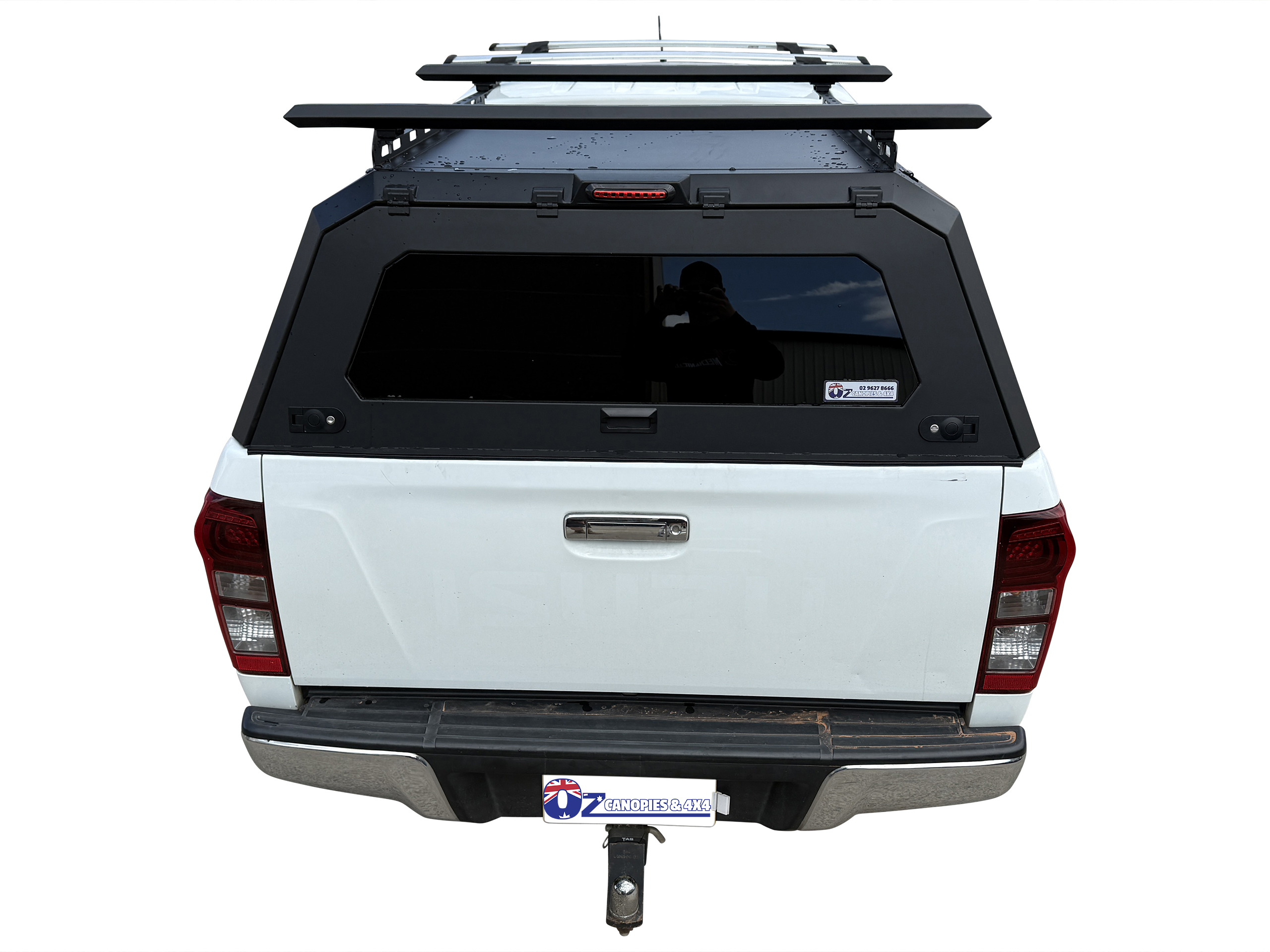
Isuzu D-MAX Towing with a Canopy: Payload, GCM and Setup Tips
The Isuzu D-MAX is a popular towing ute, especially for caravan owners, tradies, campers and touring families. But fitting a canopy changes the towing conversation.
The canopy itself adds weight. Then come drawers, fridge slides, roof racks, awnings, recovery gear, water, tools, passengers and dog gear. If you are also towing, tow ball download adds more weight to the vehicle and can push the rear axle harder than people expect.
The issue is not whether a D-MAX can tow with a canopy. It can. The real question is whether the full setup stays within GVM, GCM, axle load and payload limits once it is loaded for a real trip.
Quick answer: can you tow with an Isuzu D-MAX canopy fitted?
Yes. A canopy can be used while towing, but its weight and accessories reduce available payload. Before towing, calculate the full vehicle load including canopy, drawers, roof racks, passengers, gear and tow ball download. The D-MAX may be rated for up to 3,500 kg braked towing when properly equipped, but GVM, GCM, rear axle load and payload still matter.
Does a Canopy Affect D-MAX Towing?
Yes, but not by changing the tow rating directly
A canopy does not usually change the D-MAX’s advertised 3,500 kg braked towing capacity. What it does is add weight to the vehicle, which reduces available payload. That matters because towing adds tow ball download to the vehicle as well. Once the canopy, accessories, passengers and ball weight are all counted, the remaining payload margin can shrink fast.
The canopy is only the start of the towing load
A towing Isuzu D-MAX canopy setup typically includes the canopy, a drawer system, fridge slide, roof racks, awning, 12V battery system, recovery gear, water, tools, camping gear, dog gear, passengers and tow ball download. Each item on its own seems manageable. Stack them together and the numbers tell a different story.
Why this matters
The tow rating tells you what the D-MAX may be able to pull. Payload and GVM tell you what the D-MAX can carry while doing it. These are different numbers with different limits and both need to be respected at the same time.
Isuzu D-MAX Towing Specs: The Numbers That Matter
Current D-MAX towing and weight figures
| Spec area | Official D-MAX figure |
| GVM | 3,000 kg (4×2 High Ride), 3,100 kg (4×4) |
| GCM | 5,850 kg or 6,000 kg depending on variant |
| Payload | Approx. 930 – 1,350 kg depending on variant |
| Braked towing | 3,500 kg |
| Unbraked towing | 750 kg |
| Maximum tow ball download | 350 kg with genuine Isuzu tow kit |
| Front axle rating | 1,450 kg |
| Rear axle rating | 1,910 kg |
These figures vary by D-MAX variant. A fully optioned 4×4 X Terrain has a kerb weight of approximately 2,170 kg, leaving roughly 930 kg of payload. A lighter SX 4×2 Single Cab may have over 1,300 kg of payload. The same canopy setup affects each variant differently because the starting weight is different.
Why payload varies by D-MAX variant
Payload depends on GVM, kerb weight, engine (3.0L or 2.2L), 4×2 vs 4×4, cab style, ute vs cab chassis, factory accessories and the tray or body fitted. The official D-MAX spec sheet defines payload as GVM minus kerb weight, which is the formula to use when planning a canopy towing setup.
Why “3,500 kg towing” is not the full answer
A D-MAX may be rated to tow 3,500 kg braked, but that does not mean you can load the ute to GVM and tow a full 3,500 kg trailer at the same time. GCM creates an overall cap. A D-MAX with a GCM of 6,000 kg cannot weigh 3,100 kg loaded and tow 3,500 kg because the total would be 6,600 kg, well over the GCM limit.
Real world tow testing confirms this. Independent reviews have noted that higher spec D-MAX variants like the X Terrain, with kerb weights around 2,170 kg, may have as little as 350 kg of usable payload when towing at the maximum 3,500 kg rating, once GCM is factored in. That 350 kg has to cover the driver, passengers, fuel, canopy, accessories and tow ball download. The maths gets tight very quickly.
GVM, GCM and Payload Explained for D-MAX Towing
GVM: vehicle loaded weight
GVM is the maximum legal weight of the D-MAX when fully loaded. It includes the vehicle, fuel, driver, passengers, canopy, drawers, tools, camping gear, water, fridge, roof racks, awning, dog and tow ball download. Everything on or in the ute counts.
GCM: vehicle plus trailer
GCM is the maximum combined weight of the loaded D-MAX plus the loaded trailer. That means:
Loaded D-MAX + loaded trailer = combined mass
If the D-MAX is heavily loaded with canopy gear and accessories, the available margin for trailer weight reduces. Both limits need to be under their respective caps at the same time.
Payload: what the D-MAX can carry
Payload = GVM minus kerb weight
This is the budget for everything you add to the vehicle: passengers, fuel above the standard fill, canopy, drawers, tools, water, roof gear and tow ball download. Once the canopy setup is fitted, the remaining payload is what you have left for passengers and tow ball download on towing day.
Tow ball download: the towing weight people forget
Tow ball download is the downward force from the trailer coupling onto the D-MAX’s tow bar. The D-MAX allows a maximum of 350 kg with the genuine Isuzu tow kit.
Tow ball download counts as load on the vehicle. If a caravan puts 280 kg on the ball, that 280 kg must be considered alongside the canopy weight, passengers, drawers, roof gear and everything else already on the D-MAX. It is not “free” weight that exists outside the payload calculation.
Rear axle load: the number that catches people out
The D-MAX’s rear axle is rated at 1,910 kg. Even if total GVM looks fine, the rear axle can still approach its limit because canopy weight, drawers, fridge, water and tow ball download are all concentrated at the rear of the vehicle.
With canopy towing setups, the rear axle often becomes the critical number to watch, not just total GVM.
D-MAX Payload When Towing with a Canopy
How the payload gets used
These are planning examples, not fixed specs. Every build is different.
| Item | Example weight range |
| Aluminium canopy | 70 – 120 kg |
| Steel or heavy canopy | 100 – 180+ kg |
| Drawer system | 60 – 140 kg |
| Fridge and slide | 35 – 70 kg |
| 12V battery system | 25 – 60 kg |
| Roof platform | 20 – 35+ kg |
| Awning | 15 – 35 kg |
| Recovery gear | 30 – 80 kg |
| Water | 20 – 80 kg |
| Passengers | 150 – 300+ kg |
| Dog and gear | 20 – 80+ kg |
| Tow ball download | Often 150 – 350 kg depending on trailer |
Simple towing payload example
A D-MAX owner adds a 100 kg canopy, 90 kg drawer system, 50 kg fridge and slide, 35 kg battery system, 30 kg awning, 50 kg recovery gear, 220 kg of passengers and a 280 kg caravan tow ball download. That totals 855 kg before water, food, luggage, roof gear, dogs or tools.
On a D-MAX variant with 1,100 kg of payload, that leaves roughly 245 kg for everything else. On a variant with 930 kg of payload, the setup is already over before the dog gets in the car.
This is why towing setups can feel fine on paper until the real loaded numbers are added up.
Canopy setup can make towing better or worse
Better towing canopy setup: Lighter aluminium canopy, heavy items positioned low and forward, minimal roof load, drawers not overbuilt, water stored carefully, no duplicate caravan gear, good tie downs and load balanced before the trip.
Worse towing canopy setup: Heavy steel canopy, full drawers packed with tools, water and fuel at the rear, heavy rooftop tent on the platform, 270 degree awning plus recovery boards plus solar on the roof, caravan ball weight near maximum and no weighbridge check.
Tow Ball Download and Rear Axle Load
Why tow ball download matters so much
Tow ball download pushes weight onto the rear of the D-MAX. This reduces available payload, increases rear axle load, can change ride height, affects steering feel, increases rear suspension load, affects braking and stability and compounds with canopy and drawer weight that is already rear biased.
Ball weight is not just “trailer weight”
A caravan can be under its ATM and still put too much load on the tow vehicle. Check the actual ball weight (measured, not estimated), trailer ATM, trailer GTM, caravan internal loading balance, water tank position, gas bottle weight, front storage box weight, bike rack weight and any other trailer accessories.
Rear axle check
The rear axle rating of 1,910 kg is a hard limit. Owners towing with a canopy should check rear axle load at a weighbridge, not just total vehicle weight. A D-MAX can be under GVM overall but still be overloaded on the rear axle because the canopy, drawers and tow ball download all concentrate weight behind the rear axle line.
Weight distribution hitch
A weight distribution hitch (WDH) can help redistribute load and improve towing posture for suitable trailer combinations. Isuzu lists a WDH among genuine towing accessories alongside the tow bar kit, electronic brake controller and towing mirrors.
But a WDH does not increase GVM, GCM, axle limits or payload. It redistributes existing load across the axles. It is a handling aid, not a capacity increase. For a broader look at when a GVM upgrade makes sense for a D-MAX canopy towing setup.
Best D-MAX Canopy Setup for Towing
Choose a lightweight aluminium canopy where possible
For towing focused setups, aluminium is usually the best practical choice. It keeps the build functional without unnecessary weight, suits drawers and fridge layouts, handles roof rack and awning mounting and works well for the touring and towing crossover that many D-MAX owners need. For a detailed comparison of how aluminium and fibreglass canopies differ on the D-MAX for weight, strength and accessory compatibility.
Keep heavy gear low and forward
Heavy items like tools, recovery gear, water, the fridge, battery system and spare parts should sit low in the canopy and as far forward as practical. Avoid placing heavy items high on the roof or behind the rear axle if avoidable. This reduces rear end sag, improves handling and keeps the rear axle load more manageable.
Be selective with drawers
A drawer system can be useful for towing builds, but heavy drawers plus tow ball download can compound rear end weight. Consider a single drawer instead of twin drawers, a lighter system, removable storage tubs or a false floor setup. Only carry what the trip actually requires. For a guide to choosing the right D-MAX canopy drawer layout based on use case and weight budget.
Minimise roof weight
Towing already changes vehicle dynamics. Adding significant weight to the roof makes it worse. Be cautious with rooftop tents, full roof platforms, heavy 270 degree awnings, recovery boards, solar panels, spare wheels and jerry cans on the roof. If the gear can go inside the canopy, it should. For a detailed guide to D-MAX canopy roof rack options, load ratings and when a platform is worth the weight.
Do not duplicate caravan gear
If the caravan already has a kitchen, water, fridge, bedding, tools, chairs, table and recovery gear, the D-MAX canopy only needs the essentials. A towing canopy should support the caravan setup, not duplicate the whole caravan inside the ute.
Towing Setup by Use Case
Caravan towing setup
- Lightweight aluminium canopy
- Low mounted storage
- Essential recovery gear
- Fridge only if needed (the caravan may have one)
- Minimal roof load
- Sensible drawer system (not overbuilt)
- Towing mirrors
- Electronic brake controller
- Weight distribution hitch where suitable
- Weighbridge check before the trip
Isuzu states that D-MAX owners need a genuine Isuzu tow bar kit or tow tongue kit and an electronic brake controller for the 3,500 kg braked towing rating. For most caravan owners, the canopy should be treated as a practical support vehicle, not a second accommodation unit.
Camper trailer towing setup
- Aluminium canopy
- Lighter drawers or removable storage tubs
- Fridge and 12V power
- Awning (only if not already on the camper)
- Recovery gear
- Water planning
- Roof bars only if genuinely needed
Boat towing setup
- Corrosion conscious canopy and accessories (especially for saltwater)
- Low storage for gear
- Tie downs for wet and dry separation
- Recovery gear
- Minimal roof weight
- Spare towels, clothing and cleaning supplies
- No unnecessary permanent touring build
Work trailer towing setup
- Trade focused aluminium canopy
- Secure tool drawers
- Ladder racks if needed
- Rear axle weight check (tools plus trailer ball weight compound quickly)
- Load restraint for everything
- Do not overload the canopy and trailer at the same time
For a trade specific guide to setting up a D-MAX canopy for daily tool use alongside towing.
Touring while towing setup
- Aluminium canopy
- Moderate drawer system
- Fridge and 12V power
- Dust sealing (especially for gravel road towing)
- Recovery gear stored low
- Minimal roof weight
- Load balanced carefully
- Spare payload margin for unexpected items
For a complete guide to building a practical D-MAX touring canopy setup with the right accessory sequence and weight management.
How to Weigh a D-MAX Canopy Towing Setup
Why guessing is not enough
If you have not weighed the D-MAX and trailer in real loaded condition, you do not know your towing setup. You have an estimate. Estimates can be wrong by hundreds of kilograms.
Weigh the D-MAX without the trailer
Load it exactly as it will be used: full fuel, passengers, canopy loaded, drawers loaded, roof accessories fitted, water, food, tools and dog gear included. Record total vehicle weight, front axle weight and rear axle weight.
Weigh the trailer
Check trailer loaded weight, ATM, GTM and tow ball download. If the weighbridge can measure individual axle groups, check left and right balance as well.
Weigh the full combination
Check loaded D-MAX plus loaded trailer. Compare the combined weight against GCM. Compare the D-MAX loaded weight (including tow ball download) against GVM. Compare the rear axle load against the 1,910 kg axle rating.
Reweigh after changes
Recheck after adding a canopy, drawers, roof platform, rooftop tent, 12V system, caravan accessories, toolboxes, extra water or fuel, a GVM upgrade or suspension changes. Each addition shifts the numbers.
Load Restraint Inside the Canopy When Towing
Why towing makes restraint more important
A towing vehicle deals with different forces than a solo vehicle. Harder braking, different cornering dynamics, more weight transfer and trailer sway all put extra stress on unsecured loads inside the canopy.
The National Transport Commission’s Load Restraint Guide for Light Vehicles says loads must be restrained so they stay on the vehicle during normal driving conditions, including heavy braking, cornering, acceleration and minor collisions. Loads must not exceed mass limits or negatively affect stability. This applies directly to canopy loads on a towing vehicle.
Secure everything inside the canopy
Check drawer latches, fridge slide lock, water containers, recovery gear, tools, dog crate, gas bottles, spare parts, camp kitchen items and tie down points. Everything should be secured, not just contained.
Roof loads need restraint too
Check awning brackets, recovery board mounts, roof platform bolts, rooftop tent mounts, solar panel mounts and ladder tie downs. Australian Design Rules (ADRs), administered by the Department of Infrastructure, set baseline vehicle safety standards, but aftermarket accessories are the owner’s responsibility to install and restrain properly.
Do You Need a GVM Upgrade for Towing with a D-MAX Canopy?
Not automatically
A GVM upgrade is not required just because you fit a canopy or tow a trailer. Many D-MAX owners tow comfortably within factory limits with a sensible canopy setup.
When it may be worth considering
Consider a GVM upgrade if the loaded D-MAX is close to GVM, the rear axle is close to its 1,910 kg limit, tow ball download is high, the canopy fitout is heavy and permanent, passengers and gear leave little margin, caravan trips are frequent or tools and trade gear stay in the ute full time.
What a GVM upgrade does not automatically fix
A GVM upgrade may not increase GCM, braked towing capacity or fix poor load distribution. It does not remove rear axle concerns or make heavy roof loads safe. It increases the legal loaded weight of the vehicle, which gives more payload room, but every other limit still applies separately.
Vehicle Standards Bulletin 14 (VSB 14) provides the national technical requirements for modifying light vehicles, published by the Department of Infrastructure, Transport, Regional Development, Communications and the Arts. In New South Wales, GVM upgrades typically require certification by an approved engineer, with documentation submitted to Transport for NSW for registration update. Other states have equivalent processes.
What We Recommend at Oz Canopies & 4×4
For D-MAX owners who tow, we recommend starting with a lightweight aluminium canopy and building the setup around the towing scenario, not the other way around. If the caravan carries most of the camping gear, the canopy should carry the essentials, not duplicate everything.
Keep heavy items low and forward. Minimise roof weight. Be honest about what the D-MAX variant can actually carry once passengers, tow ball download and accessories are stacked up. And weigh the loaded ute before the first big towing trip, not after.
We deal with D-MAX towing setups every week and we know where the weight traps are. A quick conversation about your variant, your trailer and your gear usually makes the canopy setup decision straightforward.
Call us on 02 9627 8666, text 0440 130 098 or visit our showroom at 20 Walker St, South Windsor, Sydney.
Common D-MAX Towing with Canopy Mistakes
Assuming 3,500 kg towing means the whole setup is legal
The tow rating is only one limit. GVM, GCM, rear axle load and payload all have separate caps. A D-MAX can be within its tow rating but over GVM because of canopy gear, passengers and ball weight.
Forgetting tow ball download
Ball weight can consume a large part of available payload. A 300 kg ball weight on a D-MAX with 1,000 kg of remaining payload (after canopy and accessories) leaves only 700 kg for passengers, water, tools and everything else.
Ignoring rear axle load
The rear axle is often the first limit reached on a canopy towing setup. Canopy weight, drawers, fridge, water and tow ball download all sit behind the rear axle line.
Duplicating caravan gear
Carrying a full kitchen, water supply and recovery kit in both the caravan and the ute doubles the weight for no practical benefit.
Adding heavy roof accessories
Roof weight affects payload and handling. A rooftop tent plus a full platform plus an awning on a towing D-MAX is a lot of high mounted weight that makes the vehicle less stable under tow.
Overbuilding drawers
A heavy twin drawer system may not be needed if the caravan carries most of the gear. A single drawer or removable storage can save significant weight.
Not weighing the setup
Real weights beat guesses. A trip to a public weighbridge before the first towing trip takes less than an hour and gives actual numbers to work with.
Thinking suspension upgrades equal legal capacity
Upgraded springs may improve ride and load control, but they do not increase the legal GVM unless they are part of a certified GVM upgrade. A stiffer ride does not make overloading legal. Understanding the key things to consider before buying a ute canopy helps frame the weight conversation before the build begins.
Loading heavy items behind the rear axle
Heavy gear stacked at the back of the canopy, right above the tow ball, worsens rear axle load and towing stability. Move heavy items forward wherever possible.
D-MAX Canopy Towing Checklist
Before towing, check every item on this list.
| Area | What to confirm |
| D-MAX variant | GVM, GCM, payload, axle ratings for your specific model |
| Tow equipment | Tow bar or tongue kit, electronic brake controller, towing mirrors |
| Canopy weight | Material, accessories, roof load |
| Payload | Passengers, gear, canopy, ball weight all counted |
| Tow ball download | Actual measured ball weight, not estimated |
| Trailer weight | ATM, GTM, actual loaded weight |
| Rear axle load | Weighbridge check, not just total weight |
| Roof weight | Platform, awning, RTT, solar, boards |
| Drawer setup | Weight, restraint, fridge slide lock |
| Load restraint | Internal and roof loads secured |
| Tyres | Pressure and load rating correct |
| Suspension | Ride height, control, legal capacity |
| GCM | Loaded vehicle plus loaded trailer within limit |
| Insurance and compliance | Any modifications documented |
D-MAX Canopy Towing: FAQs
Can you tow with a canopy on an Isuzu D-MAX?
Yes. A canopy can be used while towing, but its weight and accessories reduce available payload. Check GVM, GCM, rear axle load and tow ball download before towing.
Does a canopy reduce D-MAX towing capacity?
A canopy does not usually reduce the advertised tow rating directly, but it reduces payload and can affect GVM, rear axle load and GCM once the vehicle is loaded.
What is the D-MAX braked towing capacity?
Isuzu lists 3,500 kg braked towing capacity on all D-MAX models when fitted with the genuine Isuzu tow bar kit or tow tongue kit and an electronic brake controller.
What is the maximum tow ball download for a D-MAX?
The official spec sheet lists maximum tow ball download at 350 kg when fitted with the genuine Isuzu tow kit.
Does tow ball download count as payload?
Yes. Tow ball download counts as load on the vehicle. It must be considered alongside canopy weight, passengers, drawers, roof gear and luggage.
What canopy is best for towing with a D-MAX?
A lightweight aluminium canopy is usually the best practical option because it provides secure storage and accessory flexibility without adding unnecessary weight. For a look at how D-MAX canopy pricing varies by material, features and setup level.
Do I need a GVM upgrade for towing with a D-MAX canopy?
Not automatically. Consider one only if the loaded D-MAX is close to or over GVM, rear axle limits or payload once canopy, passengers, gear and tow ball download are included.
Can I tow a caravan with drawers and roof racks fitted?
Yes, but the drawer and roof rack weight must be included in the payload calculation. Heavy drawers, roof platforms and tow ball download add up quickly.
Should I use a weight distribution hitch?
It may help in some caravan setups, but it does not increase GVM, GCM, payload or towing capacity. It redistributes load, which can improve handling and towing posture.
How do I know if my D-MAX towing setup is overweight?
Use a weighbridge. Check loaded vehicle weight, front axle load, rear axle load, trailer weight, tow ball download and full combined mass. For a broader look at how canopy fitment, model year and body style affect what you can carry and tow on the D-MAX.
Quick Decision Guide
Use this before your next towing trip.
- What is your D-MAX variant’s payload? Check the exact number. It is not the same across all variants.
- What does the canopy setup weigh? Canopy, drawers, fridge, roof gear, battery and accessories. Add it up.
- How many passengers? Each person counts against payload. Two adults add roughly 160 to 200 kg.
- What is the tow ball download? Measure it, do not guess. Ball weight eats directly into remaining payload.
- What is the rear axle load? Check at a weighbridge. The rear axle often becomes the limiting factor before total GVM does.
- Have you checked GCM? Loaded D-MAX plus loaded trailer. If the total exceeds GCM, the combination is over limit even if each individual figure looks fine.
- Can you reduce weight? Lighter canopy, fewer drawers, less roof gear, no duplicate caravan items. Every kilo saved is a kilo available for passengers and tow ball download.
The tow rating tells you what the D-MAX can pull. Payload, GVM, GCM and axle load tell you whether the whole setup still makes sense once the canopy and trailer are loaded.
Call us on 02 9627 8666, text 0440 130 098 or visit our showroom at 20 Walker St, South Windsor, Sydney.
