
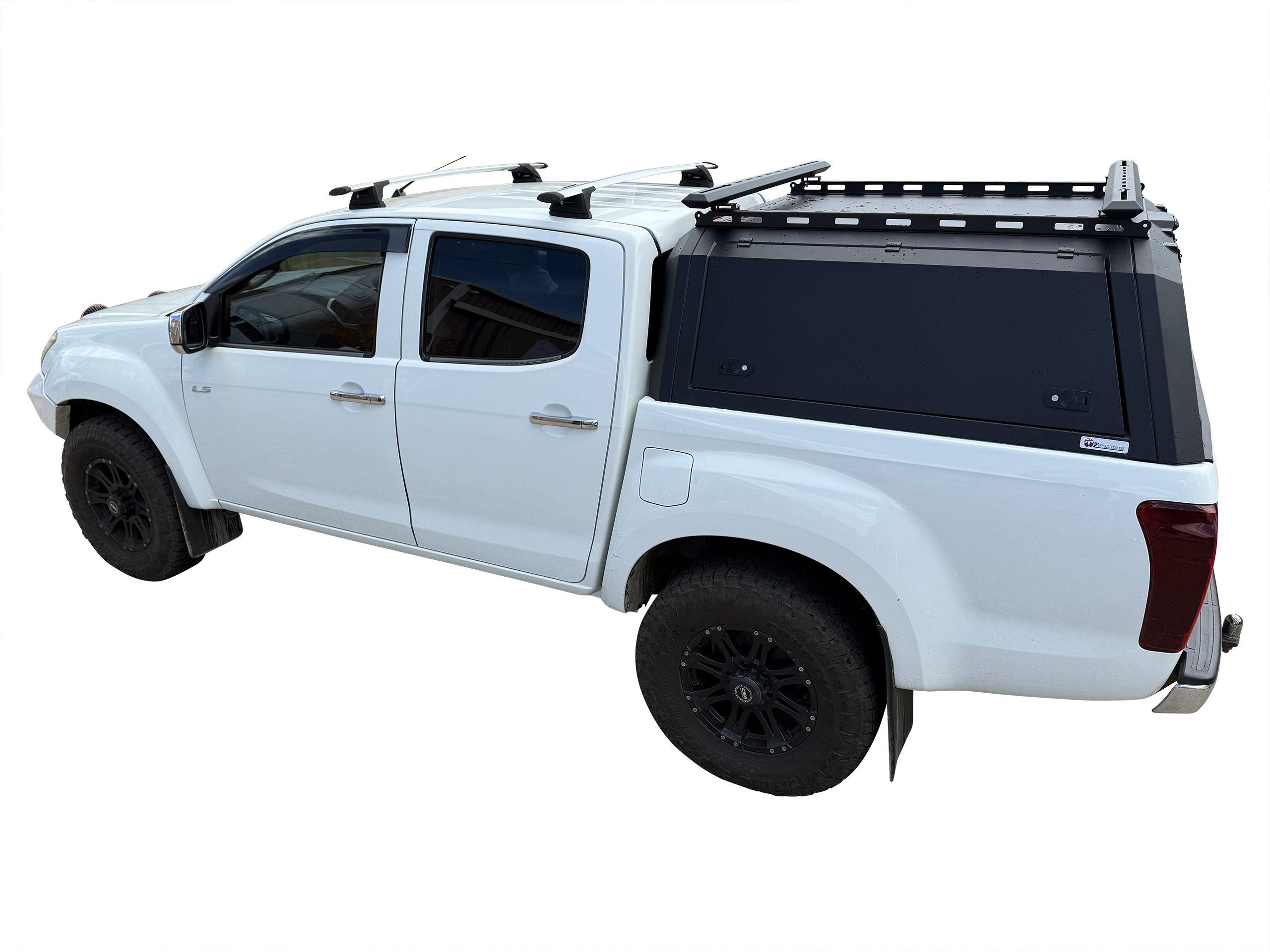
Best Isuzu D-MAX Trade Canopy Setup: Tools, Storage and Ladder Racks
A tradie does not need a D-MAX canopy just to cover the tub. They need a setup that saves time on every job, protects expensive tools overnight, handles ladders safely, keeps gear dry during a week of Melbourne rain and still leaves enough payload to carry the actual materials the job requires.
The best Isuzu D-MAX trade canopy setup is not the one with the most accessories bolted on. It is the one that makes the ute easier to work from every single day.
For tradies, the canopy has to earn its place. Secure tool storage, easy side access, ladder rack compatibility, internal organisation, lighting, weather protection and enough flexibility to suit how the business actually operates. If the canopy slows you down, it is not doing its job.
Quick answer: what is the best trade canopy setup for an Isuzu D-MAX?
For most tradies, the best D-MAX trade canopy setup is a lightweight aluminium canopy with lift up side access, secure tool drawers, internal shelving, ladder racks or roof bars, tie down points, work lighting, weather sealing and central locking where available. Aluminium is usually the best all round material because it suits tool storage, racks, accessories and daily work use better than a lifestyle focused fibreglass canopy.
What Makes a Good D-MAX Trade Canopy Setup?
A trade canopy needs to do more than store things. It needs to make work faster.
It should make work faster, not just add storage
Every tradie knows the cost of wasted time on site. The right canopy setup means faster tool access, less unpacking and repacking, better organisation so you stop losing fittings and fasteners, fewer trips back to the ute, more secure overnight storage so you are not replacing stolen gear and better separation between tools, materials and personal items.
If you spend ten minutes every morning digging through a messy canopy looking for the right fitting, a set of drawer dividers and a labelled shelf system will pay for themselves within a week.
It should suit the actual trade
Different trades have different storage needs. An electrician’s canopy looks nothing like a builder’s canopy.
- Electricians need small parts organisation, labelled bins, power tool storage, conduit carrying capacity and battery charging.
- Plumbers need pipe and fitting storage, heavy tool access, wet and dry gear separation and robust drawer systems.
- Builders need larger tool storage, fixings organisation, levels, saws and easy ladder access.
- Carpenters need long item storage organised power tool cases and dust conscious layouts.
- Mobile service technicians need drawer and shelf combinations, internal lighting, device charging and bench style access for testing and repairs.
- Landscapers need fuel and chemical safety, wet and dirty gear separation, heavy tool tie downs and easy clean surfaces.
The best D-MAX trade canopy is the one built around how you actually work, not a generic “tradie package” that tries to suit everyone.
It should handle daily use without falling apart
A trade canopy gets opened, closed, loaded and unloaded multiple times a day, five or six days a week. That is hundreds of open close cycles a month. Hinges, locks, gas struts, seals, drawer runners and side access mechanisms all need to be built for that kind of repetition.
Common mistake: Buying a canopy with cheap gas struts because they look the same as quality ones. Cheap struts lose pressure within six to twelve months and you end up propping windows open with a broom handle.
It should still respect payload
The current D-MAX range offers strong towing capability and solid payload figures, but a trade canopy setup still needs to factor tool weight, racks, drawers, passengers, materials and any trailer load into the total vehicle setup. A fully loaded trade D-MAX with a canopy, twin drawers, shelving, ladders, tools, materials, two passengers and a trailer can push towards GVM limits faster than most tradies realise. Understanding the key things to consider before buying a ute canopy helps avoid this trap early.
Best Canopy Material for a D-MAX Tradie Setup
The material choice sets the direction for everything else. Get it right and the build comes together naturally. Get it wrong and you are fighting limitations for the life of the canopy.
Aluminium canopy: best all round trade choice
For most D-MAX tradies, aluminium is the strongest recommendation. It gives you a practical, durable structure that handles the daily grind of trade work without the weight penalty of steel or the accessory mounting limitations that some fibreglass designs introduce.
Aluminium canopies suit tool drawers, internal shelving, side access panels, ladder racks, work lights and 12V charging setups. The panel construction allows bolting, riveting and adapting accessories in ways that moulded fibreglass shells cannot always match. Aluminium also resists corrosion well, which matters if you work in coastal areas or the canopy regularly gets wet from job site conditions.
A quality aluminium canopy for the D-MAX typically weighs around 70 to 100 kg. That leaves more payload for tools, materials and passengers than a heavier steel option would. For a deeper look at why aluminium ute canopies are popular across trade, touring and mixed use setups.
Fibreglass canopy: better for light duty business use
Fibreglass can work if the D-MAX is mostly a daily driver that occasionally carries tools. Sales reps, light service vehicles and work lifestyle crossover owners who want a cleaner visual appearance may prefer the smooth, colour matched look that fibreglass offers.
But for tradies who are constantly loading gear, carrying ladders and working from the ute on rough sites, fibreglass is less ideal. Accessory mounting can be limited depending on the canopy design, roof load capacity varies and the moulded shell is less forgiving of the daily impacts that trade use involves.
If you are comparing the two materials head to head for the D-MAX, the aluminium vs fibreglass canopy comparison covers the full trade off by use case.
Steel canopy: strong, but watch the weight
Steel canopies are the heavy duty option. They handle harsh worksite abuse, offer maximum impact resistance and suit mining, construction and industrial fleet environments where the canopy takes serious punishment.
The trade off is weight. Steel is noticeably heavier than aluminium and on a D-MAX where payload is shared between canopy, tools, drawers, ladders, passengers and materials, that extra weight comes directly out of what you can legally carry.
For many private D-MAX tradies, steel is more canopy than they need. Aluminium handles most trade environments without the payload penalty.
Best Access Setup for a D-MAX Trade Canopy
Access is the single biggest workflow factor in a trade canopy. Get it wrong and you waste time on every job.
Side access is more important than most people think
Rear only access sounds fine until you are on your third job of the day and need to reach a tool case that has been pushed to the front of the canopy by everything loaded after it. Tools get buried. Gear has to be pulled out to reach other items. Heavy items become harder to grab. Workflow slows down.
Side access doors solve this. They let you reach tools, parts and equipment from the side of the ute without opening the tailgate, pulling drawers out or climbing into the canopy.
Lift up side windows or gullwing doors
Lift up side panels with gas struts are the most popular access style for trade canopies. They open upward and outward, giving you a clear opening to reach shelving, tool cases and parts bins. Gullwing style doors offer even wider access on some designs.
Things to consider: opening height (will it hit a carport roof if parked close?), strut quality (needs to hold up over thousands of cycles), weather sealing (gaps let rain onto tools), lock quality (the side door is a security point) and whether the open door blocks access in tight spaces like narrow driveways or loading docks.
Rear access still matters
Side access handles daily tool retrieval. Rear access handles the bigger stuff. Drawers, larger tools, toolboxes, cable drums, wet gear, building materials and site clean up equipment all benefit from full rear access.
A good trade canopy setup uses both. Side doors for the things you grab constantly. Rear access for the things you load and unload at the start and end of each job.
Sliding windows are usually not enough for trade use
Sliding windows can add ventilation, but they do not give you enough opening to actually access tools effectively. For a serious trade setup, lift up side panels are the minimum. Sliding windows are a supporting feature, not a replacement.
Tool Storage Layout for a D-MAX Trade Canopy
The internal layout should be designed around how you work, not how it looks in a catalogue photo.
Start with your most used tools
Before buying drawers, shelves or storage systems, list your tools in order of how often you use them.
- Tools used every single job
- Tools used most days
- Heavy tools and power tools
- Small parts and consumables
- Long tools (levels, bars, conduit)
- Wet or dirty gear
- Emergency and safety gear
- Personal items
The tools at the top of that list should be the easiest to reach. The items at the bottom can go in less accessible spots.
Drawer systems
Drawers are the backbone of most trade canopy fitouts. Options include single drawers, twin drawers, stacked shallow drawers for small parts and heavy duty systems with full extension runners.
Drawer weight matters. A heavy duty twin drawer system can weigh 80 to 140 kg before you put a single tool in it. For tradies who also need to carry materials, passengers and possibly tow a trailer, that weight needs to be factored into the payload budget.
Key point: Drawers should match the trade. A plumber, electrician and carpenter should not have the same drawer layout. A plumber needs deep drawers for fittings and heavy tools. An electrician needs shallow drawers for small parts and labelled bins. A carpenter needs a mix for power tool cases and hand tools.
Internal shelving
Shelving works well for tool cases, parts boxes, consumables, drills, batteries, small fittings, sealants and measuring gear. Adjustable shelves that can be repositioned as the business changes are better than fixed shelves that lock you into one layout forever.
Good shelving should be accessible from the side doors, rated for the weight you are putting on it and designed with lips or edges that stop items sliding off during driving. Labelling shelves and bins saves more time than most tradies expect.
Toolboxes and modular storage
Not every trade canopy needs a permanent heavy drawer system. Some tradies are better off with a lighter modular setup using removable tool cases, stackable systems, trade specific carry boxes and open bins for quick access. A modular approach lets you change the layout as the business changes without ripping out a fixed fitout.
Small parts organisation
This is critical for electricians, plumbers and maintenance technicians. Screws, connectors, fittings, clips, washers, fasteners, terminals and labels all need a home. Clear sided bins with labels are the simplest solution. Shallow stacked drawers with dividers work well in canopy setups. If small parts are loose in a bag at the bottom of a drawer, you will waste time on every job.
Separating clean and dirty gear
Wet tools, silicone tubes, adhesives, work boots, PPE, drop sheets and oily gear should not sit next to customer facing tools and clean equipment. A simple separation system, whether it is a dedicated bin, a separate drawer or a lower section of the canopy, keeps things cleaner and more professional.
Ladder Racks, Roof Bars and Long Item Storage
Ladders are one of the most common items D-MAX tradies carry and one of the most commonly under planned.
Ladder racks for a D-MAX canopy
A ladder rack needs to be rated for the weight of the ladders being carried. It needs secure mounting to the canopy roof structure. It needs tie down points to stop the ladder shifting during driving. It needs to be at a height that allows safe loading and unloading without a step ladder. And the canopy roof itself needs to be rated for the combined weight of the rack and whatever is on it.
Some ladder racks include a rear roller to help slide ladders on and off, which is useful for solo tradies working alone. Others use side loading systems that suit tighter spaces.
Roof bars vs full roof platform
Roof bars suit most tradies. They carry ladders, conduit, timber lengths and occasional roof loads without adding excessive weight. A full roof platform gives more mounting points and broader load support, but it also adds more weight and is usually overkill for pure trade use unless the D-MAX doubles as a touring vehicle on weekends.
Most tradies should start with trade rated roof bars or ladder racks before considering a full platform.
Pipe and conduit carriers
Electricians, plumbers, HVAC technicians and builders often need to carry long items like conduit, PVC pipe, copper tube or timber lengths. Dedicated pipe carriers with lockable end caps keep these items secure, out of the weather and separate from the main canopy storage.
Carriers should be rated for the weight being carried, properly secured to the rack system and positioned so they do not overhang dangerously. The National Transport Commission’s Load Restraint Guide for Light Vehicles covers overhang limits and restraint requirements for loads on light vehicles.
Do not overload the canopy roof
This applies to every trade setup. Ladder weight, conduit, timber, the rack itself and any other roof mounted gear all count towards the canopy’s published roof load rating. Dynamic movement during driving, especially on rough work sites, puts more stress on roof mounted gear than highway driving.
Check the canopy’s specific dynamic and static load ratings before loading the roof. Australian Design Rules (ADRs), administered by the Department of Infrastructure, set baseline safety standards for vehicles, but aftermarket accessories like canopy roof racks are rated separately by the manufacturer. A canopy rated for 100 kg dynamic load does not mean you can put 100 kg of ladders, a rack and conduit on it and drive across a rough building site without risk.
Payload and Load Restraint for D-MAX Tradies
This is the section that separates a well planned trade setup from one that ends up over GVM within six months.
Why tradies overload utes without realising
A D-MAX trade setup gets heavy fast because the weight builds up gradually. You start with a canopy. Then drawers. Then shelving. Then tools. Then ladders. Then a roof rack. Then materials for a job. Then a passenger. Then a trailer. Each addition seems small, but the total stack adds up to a serious number.
| Item | Example weight range |
| Aluminium canopy | 70 – 120 kg |
| Drawer system | 60 – 140 kg |
| Shelving and tool fitout | 30 – 100 kg |
| Ladder racks and roof bars | 20 – 50 kg |
| Ladders | 15 – 60 kg |
| Power tools and toolboxes | 80 – 250+ kg |
| Materials and consumables | 50 – 300+ kg |
| Passengers | 80 – 200+ kg |
| Trailer tow ball download (if towing) | Varies |
These are examples, not fixed specs. But a moderate trade setup with drawers, shelving, tools, ladders, a roof rack, one passenger and a load of materials can easily hit 500 to 800 kg. Compare that against the D-MAX’s available payload (roughly 930 to 1,310 kg depending on variant) and the maths gets tight, especially if towing.
Common mistake: Never weighing the loaded ute. Many tradies have no idea how close to GVM they are running until they hit a weigh station or get inspected. The D-MAX holds a five star ANCAP safety rating in factory condition, but that rating assumes the vehicle is operating within its rated weight limits. Running over GVM compromises braking, handling and suspension performance. A trip to a public weighbridge costs next to nothing and gives you an actual number to work with.
Load restraint inside the canopy
The National Transport Commission says light vehicle loads must be restrained so they stay on the vehicle during normal driving conditions, including heavy braking, cornering, acceleration and minor collisions. Drivers must be able to demonstrate that their restraint method complies with the law.
For a trade canopy, this means:
- Drawers must lock closed so they do not slide open under braking
- Toolboxes must be secured, not just sitting loose on a shelf
- Shelving should have lips or edges to stop items sliding off
- Ladders on the roof rack must be tied down, not just resting on crossbars
- Gas bottles must be stored upright, secured and valve capped
- Heavy power tools should be in locked cases or restrained drawers
- No loose heavy objects anywhere in the canopy
A canopy contains your gear, but it does not restrain it. Everything inside still needs to be secured properly.
When a GVM upgrade may be worth considering
If the D-MAX carries tools full time, has a heavy canopy and drawer setup, carries ladders and materials daily, tows a trailer often and has a bull bar, winch or underbody protection fitted, it may be running close to or over the factory GVM limit.
A GVM upgrade increases the legal maximum weight the vehicle can carry through suspension upgrades, compliance testing and re plating. Vehicle Standards Bulletin 14 (VSB 14) provides the national technical requirements for modifying or constructing light vehicles, published by the Department of Infrastructure, Transport, Regional Development, Communications and the Arts. Administrative requirements are handled by each state and territory registration authority. In Victoria, modifications like GVM upgrades typically require certification through the Vehicle Assessment Signatory Scheme (VASS).
Security Features Tradies Should Prioritise
Tool theft costs Australian tradies millions every year. A canopy without decent security is just a roof with handles.
Lockable side access
Every side door, rear door and drawer on a trade canopy should lock. If you park the ute on a worksite overnight, at a supply yard or even in a driveway, unlocked access points are an invitation. Quality locks with weather resistant mechanisms last longer and are harder to force than cheap barrel locks.
For a deeper look at which type of locks are most secure for ute canopies and how different locking systems compare.
Central locking
Central locking integration lets you lock and unlock the canopy with the vehicle’s key remote. This is a convenience and security feature. You are less likely to forget to lock the canopy if it locks automatically with the car. Not all canopies support central locking integration with the D-MAX, so check compatibility before buying.
Solid panels vs glass windows
Solid side panels offer maximum security. No glass to break, no visibility into the canopy for opportunistic thieves and a stronger structure for mounting shelving on the inside.
Glass windows suit D-MAX owners who use the ute for both work and family or lifestyle driving. They let in light, allow visibility and look less commercial. But glass is a weaker security point than a solid panel.
For pure trade use, solid panels are usually the better choice. For work lifestyle crossover, glass lift up windows with quality locks are a reasonable compromise.
Alarm and tracking considerations
Vehicle alarm integration, tool tracking tags (GPS or Bluetooth) and engraving or marking high value tools are all worth considering. Insurance documentation of tool values and serial numbers can also make a claim easier if theft does occur. None of these replace good locks and solid panels, but they add extra layers.
Weather Protection and Dust Sealing for Work Gear
Tradies carry gear that should not get wet. Power tools, batteries, electrical components, plans, documents, timber, adhesives, paints, hardware and PPE all suffer when exposed to rain and dust.
Why weather protection matters for trade gear
A single rain event can damage hundreds of dollars worth of tools and materials if the canopy leaks. Moisture inside the canopy also creates condensation, which can cause rust on steel tools, corrosion on battery terminals and mould on soft materials stored in sealed containers.
Water resistance vs waterproof expectations
No ute canopy should be treated as a sealed submarine. Quality canopies are designed to be weather resistant, meaning they keep rain out under normal driving conditions. But heavy rain, creek crossings, high pressure washing and extended exposure can still allow moisture through gaps in seals, around the tailgate and at tub liner edges.
Good fitment, quality canopy to tub seals and proper installation are the best defences. If you regularly work in wet conditions, store moisture sensitive tools in sealed cases inside the canopy rather than relying on the canopy alone.
Dust sealing for trade vehicles
Dust matters for tradies who work on building sites, regional properties, unsealed roads and anywhere that kicks up dirt. Tailgate gaps, canopy seals, tub liner gaps and drawer ventilation can all let fine dust in.
Positive pressure vent systems push filtered air into the canopy to stop dust being sucked in through gaps. If your D-MAX regularly drives on unsealed surfaces, dust sealing should be part of the canopy build from day one.
Work Lighting and Power Setup
A dark canopy is useless during early starts, winter evenings and emergency callouts. Lighting and power should be part of the trade canopy plan, not an afterthought.
Internal canopy lighting
LED strip lighting along the canopy roof line gives even illumination for finding tools and parts. A switched rear light near the tailgate helps during loading and unloading. Side door lights that activate when the panel is opened are useful for quick access jobs.
Keep switches accessible. Avoid harsh cool white glare. Warm white or neutral white LED strips are easier on the eyes during early morning starts.
External work lights
Rear facing work lights mounted on the canopy or roof rack give you a lit work area behind the ute. These are valuable for early starts, night callouts, mobile service work, roadside repairs and loading or unloading in poorly lit areas.
12V and charging setup
A basic 12V setup in the canopy can power tool battery chargers, USB sockets, internal lighting and a small inverter for laptop or device charging. For tradies who also use the D-MAX for weekend touring, a more comprehensive dual battery system with a DC DC charger and solar input gives you fridge power and camp lighting as well.
Plan the wiring route during canopy installation. Running cables after drawers, shelving and accessories are already fitted is harder and more expensive.
Power setup by trade
| Trade | Useful power setup |
| Electrician | Battery charging, small inverter, internal lighting |
| Plumber | Lighting, pump and tool charging, compressor support |
| Builder | Tool battery charging, work lights, USB sockets |
| Mobile technician | Laptop and device charging, internal lights, inverter |
| Landscaper | Lighting, battery tool charging, compressor support |
Recommended D-MAX Trade Canopy Setups by Trade
Every trade has different priorities. Here is what a sensible starting setup looks like for six common trade types.
Electrician D-MAX canopy setup
- Aluminium canopy with lift up side access
- Shallow parts drawers with dividers and labels
- Clear sided storage bins for fittings and terminals
- Power tool shelving
- Conduit carrier on roof rack
- Battery charging (12V with small inverter)
- Internal LED lighting
- Central locking
Priority: Small parts organisation and fast access to fittings.
Plumber D-MAX canopy setup
- Aluminium canopy with strong lift up side access
- Heavy duty drawer system
- Pipe carrier on roof rack
- Wet and dry storage separation
- Fittings bins and parts organisation
- Work lights (internal and external)
- Heavy duty floor protection or matting
- Tie down points for heavy tools
Priority: Pipe carrying, heavy tool access and wet gear separation.
Builder D-MAX canopy setup
- Aluminium or steel canopy depending on worksite severity
- Ladder racks with rear roller
- Trade rated roof bars
- Tool drawers with dividers
- Long tool storage (levels, bars)
- Internal shelving for fixings and consumables
- Rear access for larger gear and materials
- Side access for daily tools
Priority: Ladder carrying, large tool access and materials transport.
Carpenter D-MAX canopy setup
- Aluminium canopy
- Ladder racks
- Long level and straight edge storage
- Saw and tool case storage
- Dust conscious layout (sealed cases for precision tools)
- Drawer system with dividers
- Side access panels
Priority: Long item storage, power tool protection and dust control.
Mobile service technician setup
- Aluminium canopy with full side access
- Drawer and shelf combination
- Internal LED work lights
- 12V charging (laptop, devices, tool batteries)
- Small internal workbench surface if space allows
- Clean parts storage with labels
- Secure locking for diagnostic equipment
Priority: Device charging organised parts access and bench style workspace.
Landscaper D-MAX canopy setup
- Aluminium canopy
- Tool tie downs throughout
- Wet and dirty gear separation
- Ladder and rack setup for long tools
- Fuel and chemical safety planning (ventilated storage for fuel containers)
- Weatherproof tool storage
- Heavy duty floor matting or easy clean surface
Priority: Dirty gear handling, fuel safety and heavy tool restraint.
What We Recommend at Oz Canopies & 4×4
For most D-MAX tradies, we recommend starting with a quality aluminium canopy matched to the crew cab tub, with lift up side access as a baseline. From there, the fitout depends on the trade.
Electricians usually need shallow drawers and labelled bins. Plumbers need heavy duty drawers and pipe carriers. Builders need ladder racks and bigger tool storage. The canopy is the foundation and the fitout should be built around the specific tools and workflow of the business.
We deal with tradies every week and we know which setups work and which ones end up being ripped out six months later because they did not suit the actual work. A ten minute conversation about your trade, your tools and your daily workflow usually makes the setup decision straightforward.
Call us on 02 9627 8666, text 0440 130 098 or visit our showroom at 20 Walker St, South Windsor, Sydney.
Common Mistakes D-MAX Tradies Make With Canopy Setups
Choosing the canopy by appearance only
A colour matched canopy looks great. But if it slows down tool access, cannot handle ladder racks and has limited mounting options for shelving, it is not a good trade canopy regardless of how it looks on the driveway.
Not choosing side access
This is the mistake we see most often. Rear only access is fine for a weekend camping canopy. For a daily work vehicle where you are accessing tools ten or twenty times a day, side access panels save serious time.
Overbuilding the fitout
Too many drawers, too many shelves and too many fixed accessories can create unnecessary weight and complexity. A trade canopy should be practical, not a museum exhibit. Build around what you actually use daily, not what looks impressive in a build thread.
Ignoring ladder storage
Ladders should be planned from the start, not added later with a random rack bolted on as an afterthought. The rack needs to match the canopy’s roof load rating, the ladder weight and the mounting system.
Leaving tools loose inside the canopy
Loose tools are unsafe (they become projectiles under braking), noisy (every bump in the road) and inefficient (you cannot find anything). Drawers, shelving, tie downs and tool cases fix this. The investment in organisation pays back every working day.
Forgetting lighting
A dark canopy at 5:30 am in winter is painful. Internal LED lighting, a switched rear light and a work light near the tailgate area make the canopy usable in all conditions. If you are considering what accessories are essential for a well equipped ute, lighting is near the top of the list.
Not planning for future tools
Businesses change. The tools you carry in year one are not the same tools you carry in year three. A canopy setup with adjustable shelving, modular storage and flexible mounting gives you room to evolve. Fixed, non adjustable fitouts lock you into one layout forever. If you are wondering whether it is possible to customise a standard ute canopy as your needs change.
Assuming every aluminium canopy is the same
Build quality varies. Seals, locks, roof load ratings, hinges, gas struts, fitment accuracy and powder coat quality all differ between brands. Do not assume that “aluminium” automatically means “good.” The canopy design matters as much as the material. For a look at which canopy materials handle Australian heat best and how build quality affects long term performance.
What Should You Add First to a D-MAX Trade Canopy?
Order matters. Here is the recommended build sequence for a D-MAX trade canopy.
Step 1: Choose the right canopy material. Aluminium for most tradies. Steel if the worksite environment demands it.
Step 2: Choose access style. Prioritise lift up side access if the ute is used daily for work. Sliding windows are not a substitute.
Step 3: Plan tool layout. Start with the tools you use most often and work outward from there.
Step 4: Add drawers and shelving. Keep them practical, not excessive. Match the drawer layout to the trade.
Step 5: Add ladder racks or roof bars. Match the rack to the ladders, conduit, timber or pipe you actually carry. Check the canopy roof load rating.
Step 6: Add lighting and power. Internal LEDs, a rear work light and 12V charging make the canopy usable in all conditions.
Step 7: Add security. Locks on every access point. Central locking if available. Solid panels for high security trade setups.
Step 8: Check payload and load restraint. Do this before the vehicle becomes permanently overloaded. Weigh the loaded ute. Check GVM. Secure everything inside.
Best D-MAX Trade Canopy Setup: FAQs
What is the best canopy for a D-MAX tradie?
For most tradies, an aluminium canopy is the best choice because it suits tool storage, side access, ladder racks, drawers, shelving and daily work use.
Is aluminium or fibreglass better for a tradie D-MAX?
Aluminium is usually better for tradies. Fibreglass can work for light duty business use, but aluminium is more practical for tools, racks, accessories and repeated worksite use.
Should a D-MAX trade canopy have side access?
Yes. Side access is one of the most useful features for tradies because it lets you reach tools without unpacking the entire canopy from the rear.
Can you fit ladder racks to a D-MAX canopy?
Yes, but the ladder rack, canopy and mounting system need to be properly rated for the load. Check the canopy’s published roof load rating and the rack’s separate weight limit.
What should tradies put inside a D-MAX canopy?
Common additions include tool drawers, internal shelving, small parts storage, work lights, tie down points, battery charging, ladder racks and lockable storage.
Is a steel canopy better for tradies?
Steel can be useful for heavy duty fleet or industrial use, but it is heavier. Many tradies are better served by aluminium because it balances strength, practicality and weight.
Does a trade canopy affect D-MAX payload?
Yes. The canopy, drawers, shelves, tools, ladders, passengers, materials and any trailer load all affect total payload. Check the D-MAX variant’s GVM and kerb weight to understand available capacity.
Do I need a GVM upgrade for a D-MAX trade setup?
Not always. But if the D-MAX carries heavy tools full time, has a heavy canopy fitout, carries ladders and materials daily or tows often, it is worth checking the loaded weight against the GVM limit.
Are D-MAX trade canopies waterproof?
Quality canopies are designed to be weather resistant. Water resistance depends on the canopy design, seals, tailgate gaps, tub liner and installation quality. For sensitive tools, use sealed cases inside the canopy as an additional layer of protection.
What is the best D-MAX canopy setup for electricians?
A good electrician setup usually includes an aluminium canopy, lift up side access, shallow parts drawers with labelled bins, power tool shelves, a conduit carrier, battery charging and internal LED lighting.
Quick Decision Guide
Use this to figure out your starting point.
- What trade are you in? The trade determines the storage layout. Electrician, plumber, builder, carpenter, mobile tech and landscaper setups all look different.
- Do you carry ladders or long items? If yes, plan the ladder rack and canopy roof rating from day one, not as an afterthought.
- How many times a day do you access the canopy? More than five times: you need side access, not just rear access.
- How heavy is your daily tool load? Weigh it. Compare against your D-MAX variant’s payload. If it is tight, keep the canopy and fitout lightweight.
- Do you work alone or with a passenger? Passenger weight counts against payload. A heavy trade setup with two people on board is a different calculation to solo work.
- Do you tow? If yes, every kilo of canopy and tools matters because tow ball download also counts against available payload.
- What does the business look like in two years? Choose a setup that can adapt. Adjustable shelving, modular storage and flexible mounting give you room to grow.
A good trade canopy makes the D-MAX easier to work from every day. Build it right and you will wonder how you ever worked without it.
Call us on 02 9627 8666, text 0440 130 098 or visit our showroom at 20 Walker St, South Windsor, Sydney.
