
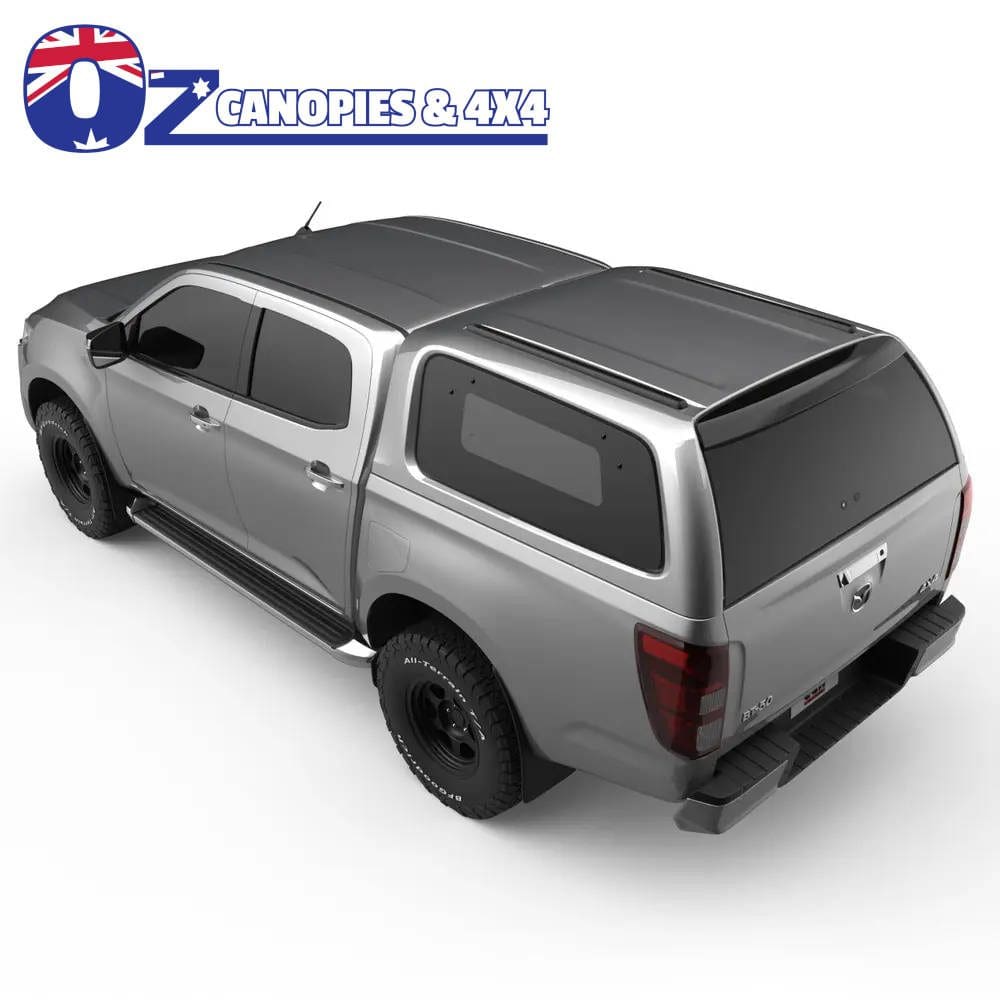
BT-50 Recovery Gear Checklist: What to Carry and Where to Store It
You don’t plan to get bogged. Nobody does. But drive a loaded BT-50 onto a sandy beach approach, a rain soaked access track or a muddy campsite entrance and suddenly the rig is going nowhere. What happens next depends entirely on whether you’ve got the right gear and whether you can actually get to it.
The two most common recovery gear mistakes are carrying nothing at all (“I’ll be fine, it’s just a gravel road”) and carrying everything but burying it under drawers, camping gear and a week’s worth of food so it takes 20 minutes to access when you need it in 30 seconds.
Good recovery gear is about having the right rated equipment, knowing how to use it safely and storing it where you can reach it without unpacking the entire canopy. For a BT-50 with a canopy build, storage and accessibility are just as important as the gear itself.
This guide covers what recovery gear a BT-50 canopy owner should carry, how each item works, where to store it in the canopy layout and the safety rules that keep a recovery from turning into an injury.
For the full canopy build picture, the Mazda BT-50 canopy setup guide covers everything from canopy selection to payload maths. For touring specific builds, the BT-50 touring canopy setup guide covers how recovery gear fits into the full build.
Quick answer: what recovery gear should a BT-50 carry?
The answer depends on where you drive. Not every BT-50 needs a full expedition recovery kit. But any BT-50 that leaves sealed roads should carry the basics.
Minimum kit for gravel roads and light off road:
- Rated recovery boards (pair)
- Rated snatch strap (8,000 to 11,000kg MBS)
- Two rated bow shackles (4.75t WLL minimum)
- Recovery damper or blanket
- Work gloves
- Tyre deflator and 12V compressor
- Tyre repair kit (plug type)
Recommended kit for touring and regular unsealed roads: All of the above, plus:
- Rated recovery points (front and rear)
- Long handle shovel
- UHF radio
- First aid kit
- Fire extinguisher (1kg ABE, mounted accessibly)
- Personal locator beacon (PLB)
- Torch or headlamp (with spare batteries)
- Rated tree trunk protector (if recovering off trees)
- Tow hitch receiver and rated pin
Extended kit for remote travel: All of the above, plus:
- Winch (if fitted) with rated extension strap
- Snatch block or pulley for winch redirection
- Second snatch strap (for double length or backup)
- MaxTrax or equivalent (larger, heavier duty boards)
- Hi lift or exhaust jack
- Additional water and fuel reserves
- Satellite communication device (PLB or satellite messenger)
- Basic tool kit for field repairs
Why recovery gear matters more on a canopy equipped BT-50
A canopy equipped BT-50 is heavier than a stock one. That extra weight, typically 200 to 400kg of canopy, drawers, tools and gear, changes how the vehicle behaves when it gets stuck.
Heavier vehicles sink deeper. A stock BT-50 at 2,100kg sinks into soft sand differently from a loaded BT-50 at 2,700kg. The extra weight pushes the tyres further into soft ground, making self recovery harder and requiring more force from straps, boards or a winch.
Heavier vehicles need higher rated gear. A snatch strap rated at 5,000kg MBS (minimum breaking strain) might be adequate for a stock BT-50. But a loaded BT-50 at 2,700 to 3,100kg needs a strap rated at 8,000 to 11,000kg MBS to provide a safe working margin. The general rule is that the strap’s MBS should be at least two to three times the stuck vehicle’s weight.
Heavier vehicles generate more force during recovery. The kinetic energy involved in a snatch strap recovery is directly related to the vehicle’s weight. Heavier vehicles mean higher forces on the strap, shackles, recovery points and both vehicles involved. Under rated gear in a heavy recovery can fail catastrophically.
The BT-50 payload and GVM guide covers how canopy weight adds up across the build. Knowing your actual loaded weight helps you choose gear rated for the right forces.
Common mistake: Using recovery gear rated for a stock ute on a fully loaded canopy build. The loaded weight can be 500 to 800kg more than the stock kerb weight. Recovery gear needs to be rated for the actual loaded vehicle weight, not the brochure kerb weight.
Recovery boards: the first tool most BT-50 owners should reach for
Recovery boards (like MaxTrax, Exitrax, Tred or similar) are the most versatile and most frequently used recovery tool. They work in sand, mud, snow and on loose gravel without needing another vehicle, a winch or any other equipment.
How they work
Place the boards in front of (or behind) the stuck tyres. The board’s surface gives the tyre something to grip instead of digging into soft ground. Drive slowly and steadily onto the board and out of the bog. No snatching, no dramatic forces, no risk of gear failure.
What to buy
Size matters for heavy BT-50 builds. Standard recovery boards are designed for vehicles up to approximately 2,500 to 3,000kg. For a loaded BT-50 at 2,700 to 3,100kg, choose boards rated for the upper end of that range or step up to a heavy duty option. Check the manufacturer’s rated vehicle weight before buying.
Nylon teeth vs moulded lugs. Different brands use different grip mechanisms. What matters is that the board provides traction on the surface you’re likely to encounter. Sand and mud require different grip characteristics. Most quality recovery boards handle both adequately.
Where to store them in the canopy
Recovery boards are one of the few items that often work better stored on the roof rack than inside the canopy. They’re flat, lightweight (3 to 5kg each) and designed for external mounting. Most roof rack and crossbar systems accept recovery board mounting brackets.
If roof space is limited (a rooftop tent takes priority), boards can be stored vertically inside the canopy against a wall or on the inside of a canopy door. They should be accessible without unpacking drawers or moving other gear.
Common mistake: Storing recovery boards at the bottom of the canopy underneath drawers and camping gear. When you’re bogged on a beach with the tide coming in, you need boards in 30 seconds, not 10 minutes.
Snatch straps: rated, maintained and stored correctly
A snatch strap is an elastic recovery strap that uses kinetic energy (from a recovering vehicle’s momentum) to pull a stuck vehicle free. It’s one of the most effective recovery tools but also one of the most dangerous if used incorrectly or with unrated gear.
What rating matters
MBS (Minimum Breaking Strain): This is the minimum force the strap can withstand before failure. For a loaded BT-50, choose a strap rated at 8,000 to 11,000kg MBS. This provides a safety margin of roughly two to three times the vehicle’s weight. The NTC Load Restraint Guide principles of rated equipment and safe working loads apply directly to recovery straps.
Common mistake: Using a cheap, unrated strap from a hardware store. Unrated straps have unknown breaking strength, unknown stretch characteristics and can fail explosively under load. Always use a purpose made, rated snatch strap from a reputable recovery gear manufacturer.
How to inspect a snatch strap
Before every use, check for cuts, abrasion, UV degradation (stiff, discoloured webbing), frayed edges, damaged or deformed eyes and any signs of heat damage or melting. A damaged strap should be retired immediately. The forces involved in a snatch recovery are severe and a weakened strap that fails under tension can whip back with lethal energy.
Where to store it
Snatch straps should be stored clean and dry. Mud, sand and grit grind into the webbing fibres and weaken the strap over time. After each use, rinse the strap with fresh water and let it dry completely before rolling and storing.
Inside the canopy, a snatch strap rolls into a compact bundle that fits in a dedicated drawer, a side pocket or a storage tub. It must be in a location you can access quickly, not buried under the camping gear.
UV protection
UV exposure degrades nylon webbing. Store the strap inside the canopy (not on the roof rack in permanent sun) when not in use. If you carry it externally, use a UV resistant bag or cover.
Shackles, recovery points and connection hardware
Bow shackles
Bow shackles are the connection point between the snatch strap and the vehicle’s recovery points. They need to be rated and appropriately sized.
For a loaded BT-50: Use bow shackles with a WLL (Working Load Limit) of at least 4.75 tonnes. The WLL is typically one sixth of the shackle’s breaking load, which provides a substantial safety margin for dynamic recovery forces.
Always use the pin supplied with the shackle. Never substitute a bolt, wire or improvised pin. Hand tighten the pin, then back it off a quarter turn so it doesn’t bind under load and can be removed afterwards.
Vehicle recovery points
The BT-50 (2020+) has factory recovery points. However, not all factory tie down points are rated recovery points. Check your specific model’s owner’s manual or compliance plate to confirm which points are rated for recovery use.
Aftermarket recovery points (from brands like ARB or Rated Recovery Point) bolt directly to the BT-50’s chassis and are rated for the vehicle’s GVM or higher. If you’re planning regular off road use, aftermarket rated recovery points on both front and rear are a worthwhile investment.
Important: Never attach a snatch strap to a towball. Towballs are not designed for the lateral and upward forces generated during a snatch recovery. A towball that fails under snatch strap load becomes a lethal projectile. This is one of the most dangerous mistakes in 4WD recovery and has caused fatalities in Australia. Always use a rated recovery point or a rated hitch receiver with a rated recovery hitch.
Recovery damper or blanket
A recovery damper (also called a recovery blanket or strap dampener) is a heavy blanket draped over the snatch strap during recovery. If the strap or a connection point fails, the damper absorbs energy and slows the whipping action of the strap, reducing the risk of injury.
A damper doesn’t prevent failure. It reduces the consequences of failure. It should be used on every snatch strap recovery, every time. No exceptions.
Any heavy blanket, purpose made recovery damper or even a heavy jacket draped over the strap at the midpoint serves this purpose. Purpose made dampers with pockets for added weight (like water bottles or sand) are more effective than a light blanket.
Air compressor, deflator and tyre repair
Why a compressor is essential for a canopy equipped BT-50
If you air down tyres for sand, corrugations or soft terrain (and you should, because it dramatically improves traction and ride quality), you need to air back up before returning to sealed roads. A loaded BT-50 running low pressures on the highway is a blowout risk, as covered in the BT-50 tyre and wheel guide.
A 12V portable compressor handles this. For a BT-50 with 265/65R17 or 265/60R18 tyres, a quality mid range compressor (rated at 72L/min or higher) re inflates each tyre from 18psi to 36psi in approximately 3 to 5 minutes. Budget compressors are slower but still get the job done.
Permanently mounted compressors (under bonnet or chassis mounted) are faster and more convenient but add weight and cost. For most BT-50 canopy owners, a quality portable 12V compressor stored in the canopy is the most practical option.
Tyre deflator kit
A rapid tyre deflator kit removes valve cores to deflate tyres quickly and evenly to a preset pressure. This is faster and more accurate than manually bleeding air through the valve.
For a loaded BT-50, airing down to 18 to 22psi is typical for sand. For corrugations, 25 to 28psi improves comfort without excessive sidewall flex. Always use a quality pressure gauge (not the cheap pencil type) to set and verify pressures.
Tyre repair kit
A plug style tyre repair kit handles punctures from nails, screws and small objects in the tread area. These kits are compact, lightweight and can get you to the nearest tyre shop without changing to a spare.
Limitations: Plug repairs are temporary. They don’t fix sidewall damage, large cuts or bead damage. A plugged tyre should be professionally inspected and permanently repaired or replaced at the earliest opportunity.
Fire safety and first aid
Fire extinguisher
A 1kg ABE rated fire extinguisher is the minimum for any canopy build. ABE covers Class A (wood, paper, textiles), Class B (flammable liquids) and Class E (electrical) fires, which covers the most common vehicle fire scenarios.
Mount it accessibly. A fire extinguisher buried in the bottom drawer is useless when you need it in five seconds. Mount it inside the canopy near a door opening (tailgate or side door) where you can grab it without reaching past anything. Quick release brackets are available for this purpose.
Check the gauge regularly. Fire extinguishers have a pressure gauge. If the needle is in the red zone, the extinguisher needs servicing or replacement. Check it every time you check your other gear.
First aid kit
A comprehensive first aid kit is essential. St John Ambulance and Red Cross both offer vehicle and remote area first aid kits designed for Australian conditions.
For touring builds heading remote: Consider a snake bite kit, burns kit and a basic splinting set in addition to the standard first aid contents. Know what’s in the kit and how to use it before you need it.
Store it accessibly. Like the fire extinguisher, the first aid kit needs to be reachable quickly. A dedicated spot in the top drawer, on a canopy shelf or in a side access compartment works best.
Personal locator beacon (PLB)
For any BT-50 owner travelling remote or off grid, a PLB registered with AMSA (Australian Maritime Safety Authority) is a genuine safety essential. When activated, it sends your GPS coordinates to the Australian rescue coordination centre. It’s the last resort when everything else has gone wrong and you need help.
PLBs are compact (pocket sized), require no subscription and last 5 to 10 years on a single battery. Registration with AMSA is free. There’s no reason not to carry one if you leave the mobile coverage area.
Common mistake: Relying on mobile phone coverage as the only emergency communication. Large parts of regional and remote Australia have no mobile coverage. A PLB works anywhere via satellite.
Where to store recovery gear in a BT-50 canopy
Storage placement is one of the most overlooked parts of a recovery gear setup. The gear is only useful if you can actually get to it when the vehicle is stuck.
The golden rule: accessible without unpacking
Recovery gear should be stored where you can reach it without moving drawers, lifting camping gear, opening multiple compartments or climbing into the canopy. When you’re bogged, you want the gear in your hands within 60 seconds.
Recovery boards: roof rack or canopy wall
Recovery boards are best stored on the roof rack in external mounting brackets, flat against the inside of a canopy wall or in a dedicated vertical slot beside the drawers. External roof rack mounting is the most popular and most accessible option for touring builds.
Weight consideration: A pair of boards weighs 6 to 10kg. On the roof, this counts toward your canopy’s dynamic roof load rating. The BT-50 roof load limits guide covers how to calculate the real world roof load with recovery boards and other accessories.
Snatch strap, shackles and damper: top drawer or side access
These items are compact when rolled or bagged. A dedicated spot in the top drawer (the first drawer you open from the tailgate) or in a side access compartment near a lift up window is ideal. Bundle them together in a canvas bag so they don’t scatter through the drawer.
Compressor and deflator: accessible but protected
The compressor is a precision tool. It needs protection from dust, moisture and impact but also needs to be accessible without dismantling the layout. A padded bag in the top drawer, a dedicated shelf in the canopy storage unit or a mounted bracket on the canopy wall all work.
Fire extinguisher: mounted near a door
Quick release bracket mounted on the canopy wall near the tailgate or a side door. Grab and go. No digging.
First aid kit: top of the layout, never buried
First aid needs to be the most accessible item in the canopy. Period. Top drawer, door mounted pouch, canopy shelf or a dedicated clip on position near a door opening.
The BT-50 drawer systems guide covers how drawer layouts and storage systems integrate with recovery gear placement.
Recovery gear weight and how it affects BT-50 payload
Recovery gear isn’t weightless. A full kit adds meaningful weight to the build.
Recovery gear weight breakdown:
| Item | Typical Weight |
| Recovery boards (pair) | 6 to 10kg |
| Snatch strap (9,000kg MBS) | 2 to 3kg |
| Bow shackles (pair) | 1 to 2kg |
| Recovery damper | 1 to 2kg |
| Tree trunk protector | 1 to 2kg |
| Work gloves | 0.3kg |
| 12V compressor (portable) | 4 to 8kg |
| Deflator kit and gauge | 0.5kg |
| Tyre repair kit | 0.5kg |
| Fire extinguisher (1kg ABE) | 2kg |
| First aid kit | 1 to 2kg |
| PLB | 0.3kg |
| Shovel | 2 to 3kg |
| Torch/headlamp | 0.3kg |
| Canvas storage bag | 0.5kg |
| Minimum kit total | ~15 to 20kg |
| Full touring kit total | ~25 to 40kg |
On a BT-50 with roughly 1,000kg of payload, a full recovery kit at 30kg is 3% of your total capacity. It’s not a huge number on its own, but it adds to the canopy, drawers, fridge, battery, water and everything else.
Common mistake: Not including recovery gear weight in the payload maths when planning the build. It’s tempting to think “recovery gear doesn’t weigh much.” Individually, no. But 25 to 40kg adds up when you’re already running tight on payload.
How to use recovery gear safely: the basics that save lives
This isn’t a full recovery training course. But these fundamentals are non negotiable.
Before any recovery
Assess the situation. How badly is the vehicle stuck? Can you self recover (boards, reverse, dig)? Or do you need another vehicle (snatch strap)? Can you winch out? Is the ground getting worse (tide, rain, sinking)?
Check all gear before connecting. Inspect the strap for damage. Check shackle pins. Confirm recovery points are rated and solid. Look at the other vehicle’s recovery points too.
Clear the area. No bystanders within two strap lengths of the recovery. If a strap or shackle fails, the recoil zone extends far beyond what most people expect. Children and onlookers should be well back.
During a snatch strap recovery
Attach the strap to rated recovery points only. Never to a towball, never to a bull bar, never to a tie down hook. Only rated recovery points bolted to the chassis.
Use a recovery damper. Drape it over the strap at the midpoint. Every time.
The recovering vehicle takes up slack first, then applies a controlled pull. The stuck vehicle should be in gear, applying gentle throttle to assist. The recovering driver applies smooth, progressive power. No full throttle launches.
If it doesn’t come free on the first pull, stop and reassess. Multiple violent snatches increase the risk of gear failure. If the first attempt doesn’t work, try a different approach: dig, use boards, change the angle or call for a winch.
After recovery
Inspect all gear. Check the strap, shackles, recovery points and damper for damage. A strap that’s been stretched beyond its design limit should be retired. Shackle pins that are deformed should be replaced.
Clean and dry the strap. Rinse off mud, sand and grit. Let it dry fully before rolling and storing. Storing a wet, dirty strap degrades it faster.
Under the NTC Load Restraint Guide, all equipment used for load restraint and recovery must be rated and maintained in serviceable condition. The principles of safe working loads, inspection and retirement apply to recovery gear just as they apply to cargo restraint. Transport for NSW and equivalent state road authorities reinforce that recovery equipment must be fit for purpose.
Recovery gear by BT-50 use case
Light off road and gravel roads
What to carry: Recovery boards, tyre deflator, compressor, pressure gauge, work gloves, tyre repair kit, first aid kit, torch.
Total weight: approximately 15 to 20kg.
Storage: Boards on the roof rack or canopy wall. Everything else in one drawer or a compact bag.
Regular touring and unsealed roads
What to carry: All of the above, plus snatch strap (9,000kg+ MBS), two bow shackles (4.75t WLL), recovery damper, shovel, tree trunk protector, fire extinguisher, PLB, UHF radio.
Total weight: approximately 25 to 35kg.
Storage: Boards on roof rack. Strap, shackles and damper in top drawer. Fire extinguisher mounted near door. First aid kit on shelf or top of layout.
Remote and expedition travel
What to carry: Full touring kit plus winch extension strap, snatch block, second snatch strap, hi lift or exhaust jack, additional water, satellite messenger, comprehensive tool kit.
Total weight: approximately 35 to 50kg+ (excluding winch, which is a permanent front end accessory at 25 to 35kg).
Storage: Boards and shovel on roof. Primary recovery gear in dedicated top drawer. Winch accessories in a separate bag or drawer section. Fire extinguisher and first aid in quick access positions.
UHF radio and communication
A UHF radio is a safety tool, not just a convenience. On unsealed roads, in convoys, at river crossings and in remote areas, UHF communication lets you coordinate with other vehicles, call for help and communicate when mobile coverage doesn’t exist.
Handheld vs in cab: A handheld UHF is the simplest option (no permanent installation required). An in cab mounted unit with an external antenna provides better range and clarity. For touring builds, an in cab unit wired into the 12V system with an antenna mounted on the canopy or cab is the most reliable setup.
The BT-50 dual battery and 12V setup guide covers how to wire a UHF radio into the canopy’s electrical system.
What we recommend at Oz Canopies & 4×4
We help BT-50 owners plan canopy builds where recovery gear has a home from day one, not as an afterthought thrown into whatever space is left.
For most canopy owners who leave sealed roads occasionally: Recovery boards on the roof rack, a quality snatch strap and shackle kit in the top drawer, a portable compressor and a first aid kit. Total investment: $300 to $600. Total weight: 15 to 25kg. Fits neatly into most canopy layouts.
For touring builds: Plan the recovery gear storage during the drawer and storage layout phase. Dedicate the top drawer front section or a side access compartment to recovery. Mount the fire extinguisher near a door. Keep the first aid kit on top of the layout. This planning is part of the canopy build, not separate from it.
Our $1,999 heavy duty steel BT-50 canopy with 200kg dynamic roof load supports recovery boards on the roof rack alongside other gear. Our $3,499 fibreglass canopy with 100kg roof rails handles boards comfortably within its rating. Browse our Mazda BT-50 canopy range to start planning your build with storage and recovery in mind.
Call us on 02 9627 8666, text 0440 130 098 or visit our showroom at 20 Walker St, South Windsor, Sydney.
Common recovery gear mistakes BT-50 owners make
Carrying no recovery gear at all. “It’s just a gravel road” is how people end up stuck on a remote track with nothing to help themselves. Even a basic kit (boards, strap, shackles) covers 90% of situations.
Using unrated gear. Cheap straps, unknown shackles and improvised recovery points are a recipe for catastrophic failure. Always use purpose made, rated recovery equipment. The forces involved in a vehicle recovery are severe.
Attaching a snatch strap to a towball. Towballs are not rated for the lateral and upward forces of a snatch recovery. A towball that fails under strap load becomes a projectile. This has caused fatalities. Only use rated recovery points or a rated hitch receiver.
No recovery damper. A snatch strap under tension that fails or disconnects whips back at extreme speed. A recovery damper draped over the strap reduces the energy and slows the whip. Use one every time.
Burying recovery gear under everything else. If it takes 10 minutes to reach the snatch strap, you might as well not have it. Store recovery gear where you can access it in under 60 seconds.
Not inspecting gear before use. UV damaged straps, corroded shackles and deformed pins can fail under load. Inspect every item before every recovery.
Using recovery gear rated for a stock vehicle on a loaded canopy build. A BT-50 at 3,000kg loaded needs gear rated for that weight, not for the 2,100kg kerb weight. Under rated gear in a heavy recovery is dangerous.
Common mistake: Forgetting to re inflate tyres after airing down for off road. A loaded canopy rig at low pressure on the highway is a blowout waiting to happen. Always carry a compressor and air back up before hitting sealed roads.
FAQs
What recovery gear should a BT-50 carry?
At minimum: rated recovery boards, a snatch strap (8,000 to 11,000kg MBS), two bow shackles (4.75t WLL), a recovery damper, work gloves, a tyre deflator, a 12V compressor and a first aid kit. For touring, add a shovel, fire extinguisher, PLB, UHF radio and tree trunk protector. The exact kit depends on where you drive and how remote you travel.
Where should recovery gear be stored in a BT-50 canopy?
Recovery boards go on the roof rack in external brackets or flat against the canopy wall. Snatch strap, shackles and damper go in the top drawer or a side access compartment. Fire extinguisher mounts near a canopy door on a quick release bracket. First aid kit sits on top of the layout or on a shelf. The key rule: accessible in under 60 seconds without unpacking anything.
How much does a BT-50 recovery kit weigh?
A basic kit (boards, strap, shackles, compressor, first aid) weighs approximately 15 to 20kg. A full touring kit adds 10 to 20kg more. The total typically sits between 25 and 40kg, which is 2.5 to 4% of a BT-50’s payload. Include recovery gear weight in your payload maths when planning the build.
Do I need aftermarket recovery points on a BT-50?
The 2020+ BT-50 has factory recovery points, but check your owner’s manual to confirm which points are rated for snatch strap recovery. Aftermarket rated recovery points from brands like ARB bolt to the chassis and are rated to the vehicle’s GVM or higher. For regular off road use, aftermarket rated points on both front and rear are recommended.
Can I attach a snatch strap to a towball?
No. Never. Towballs are not designed for the lateral and upward forces of a snatch recovery. A towball that fails under strap load becomes a dangerous projectile. This has caused fatalities in Australia. Always use rated recovery points bolted to the chassis or a rated hitch receiver with a rated recovery hitch.
Do I need a PLB for touring in a BT-50?
If you travel outside mobile coverage areas, yes. A PLB registered with AMSA sends your GPS coordinates to the Australian rescue coordination centre via satellite. It works anywhere, requires no subscription and is the last resort safety device when everything else fails. Registration is free. There’s no practical reason not to carry one when travelling remote.
How often should I inspect recovery gear?
Before every use and at least once a season if stored. Check snatch straps for cuts, UV damage, fraying and stiffness. Check shackle pins for deformation and corrosion. Check recovery boards for cracks and broken lugs. Check the fire extinguisher pressure gauge. Replace or retire any damaged item immediately.
Are recovery boards enough for most situations?
For sand, light mud and loose gravel, recovery boards handle the majority of situations without needing another vehicle. They’re the first tool to reach for in most bogs. For deeper mud, steep inclines or seriously stuck vehicles, a snatch strap with a second vehicle or a winch may be needed. Carrying both boards and a snatch strap covers nearly all recovery scenarios.
Quick recovery gear decision guide: what does your BT-50 need?
Step 1: Where do you drive?
- Sealed roads only → basic tyre kit and first aid (no off road recovery needed)
- Occasional gravel and light off road → minimum kit (boards, strap, shackles, compressor)
- Regular touring on unsealed roads → full touring kit
- Remote and expedition travel → extended kit with winch accessories and comms
Step 2: How heavy is your loaded BT-50?
- Under 2,500kg → standard recovery gear ratings are fine
- 2,500 to 3,100kg → choose gear rated for the heavier end (9,000 to 11,000kg MBS straps, 4.75t shackles)
- Over 3,100kg (GVM upgraded) → ensure all gear is rated for the revised weight
Step 3: Where does the gear live in the canopy?
- Boards → roof rack or canopy wall
- Strap, shackles, damper → top drawer or side access compartment
- Fire extinguisher → quick release bracket near a door
- First aid → top of layout, always accessible
Step 4: Does everyone know how to use it?
- A recovery course or even a YouTube refresher is worth the time
- Practice using the gear before you need it in an emergency
Planning a BT-50 canopy build with recovery gear storage in mind? Tell us your canopy setup and where you travel. We’ll help you plan the layout so everything has a place and the gear you need most is always within reach.
Call 02 9627 8666, text 0440 130 098 or visit our showroom at 20 Walker St, South Windsor, Sydney.
