
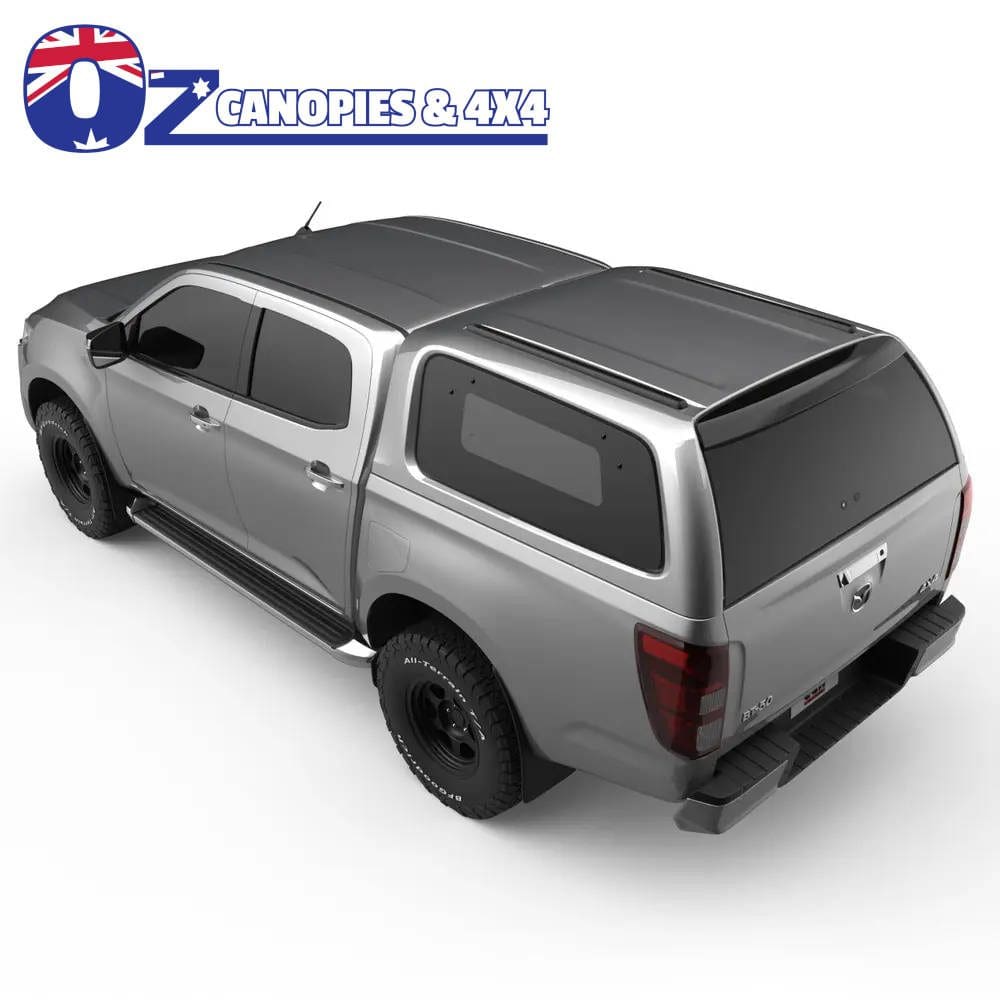
BT-50 Tyre & Wheel Guide for Canopy Builds: Load Ratings, Sizes & Offsets
Factory tyres on a BT-50 are chosen for a stock vehicle. They’re selected by Mazda to balance ride comfort, road noise, fuel economy and load capacity at the vehicle’s standard weight. They work perfectly well when the ute leaves the showroom.
Then you add a canopy, drawers, a bull bar, a towbar, tools or touring gear and suddenly the vehicle is 200 to 400kg heavier than it was when those tyres were specified. The tyres might still be within their load rating or they might not. Most BT-50 owners never check.
Tyres are the only part of the vehicle that touches the road. They carry the entire load, handle all braking, manage all cornering and absorb every road imperfection. If they’re underrated, under inflated or unsuitable for a heavy canopy build, no amount of suspension upgrades, GVM kits or careful packing will fix the fundamental problem: the tyres aren’t up to the job.
This guide covers what BT-50 owners with canopy builds need to know about tyre load ratings, sizing, pressure, tread patterns, wheel offsets and when factory tyres stop being good enough.
For the full build picture, the Mazda BT-50 canopy setup guide covers everything from canopy selection to payload maths. For suspension specific advice, the BT-50 suspension and lift kit guide covers how added weight affects springs, shocks and ride quality.
Quick answer: do you need to change tyres after adding a BT-50 canopy?
Not always. But you need to check.
Probably fine: A light canopy (55 to 70kg) with minimal accessories on a BT-50 running factory tyres with adequate load ratings. The factory tyres were specified with some payload margin. A light canopy alone likely won’t exceed that margin.
Check carefully: A canopy plus drawers plus bull bar plus tools or touring gear (200 to 350kg of permanent accessories). The combined weight of the loaded vehicle may approach or exceed the factory tyre load rating, particularly on the rear axle. Check the tyre load index against your actual loaded weights.
Likely need an upgrade: A full touring build or heavy tradie setup (300 to 500kg+ of permanent accessories) plus regular towing with heavy towball download. The rear tyres are carrying substantially more weight than they were designed for at the factory tyre spec. Upgrading to a higher load rated tyre is strongly recommended.
BT-50 factory tyre sizes (current 2020+ generation):
| Variant/Trim | Factory Tyre Size | Wheel Size |
| XS (4×2) | 255/65R17 | 17 inch steel |
| XT | 255/65R17 | 17 inch alloy |
| XTR | 265/60R18 | 18 inch alloy |
| GT | 265/60R18 | 18 inch alloy |
| SP | 265/60R18 | 18 inch alloy |
Always confirm your specific variant’s tyre size from the tyre placard on the driver’s door jamb.
What is a tyre load rating and why does it matter on a BT-50 canopy build?
Load index explained
Every tyre has a load index number moulded into the sidewall. This number corresponds to the maximum weight that tyre can carry at its specified inflation pressure.
For example, a tyre with a load index of 110 can carry 1,060kg per tyre. A load index of 116 carries 1,250kg per tyre. The difference between those two numbers is 190kg per tyre or 380kg across a pair of rear tyres. That 380kg can be the difference between a legally loaded setup and an overloaded one.
Common BT-50 tyre load index examples:
| Load Index | Max Load Per Tyre | Rear Axle Capacity (pair) |
| 110 | 1,060kg | 2,120kg |
| 112 | 1,120kg | 2,240kg |
| 114 | 1,180kg | 2,360kg |
| 116 | 1,250kg | 2,500kg |
| 118 | 1,320kg | 2,640kg |
| 120 | 1,400kg | 2,800kg |
Why this matters for canopy builds
When you add a canopy, drawers, tools, fridge, water and passengers, most of the added weight sits over or behind the rear axle. The rear tyres carry a disproportionate share of the total load.
On a heavily loaded BT-50, the rear axle can carry 50 to 60% of the total vehicle weight. If your total loaded weight is 3,000kg and 1,600kg sits on the rear axle, each rear tyre is carrying 800kg. A tyre with a load index of 110 (1,060kg max) has some margin. But add towball download (200 to 300kg, all on the rear axle) and you’re at 900 to 950kg per rear tyre. Now the margin is thin.
Common mistake: Assuming “the tyres were fine when I bought the ute” means they’re still fine after adding 300kg of permanent accessories. The tyres were specified for a stock vehicle. They weren’t specified for a canopy equipped touring rig with drawers, a fridge and a rooftop tent.
How to check your actual tyre loading
The only accurate way is to weigh the vehicle at a weighbridge that provides individual axle weights.
- Load the BT-50 exactly as you’d normally drive it (full tank, all accessories, passengers, typical cargo)
- Get individual axle weights (front and rear separately)
- Divide each axle weight by 2 to get the approximate load per tyre
- Compare each tyre’s actual load to its load index rating
If any tyre is loaded to more than 85 to 90% of its rated capacity on a regular basis, you’re running with minimal margin. On rough roads, dynamic forces temporarily exceed the static weight, which means the tyre is effectively overloaded during impacts.
The BT-50 payload and GVM guide covers the full weight calculation and how to use a weighbridge.
Tyre pressure on a loaded BT-50: why factory numbers might not be enough
Pressure and load are directly connected
A tyre’s load rating is only valid at the correct inflation pressure. Under inflated tyres can’t carry as much weight safely. The internal air pressure is what supports the load, not the rubber.
Every BT-50 has a tyre placard (usually on the driver’s door jamb) that lists recommended pressures for different load conditions. Most placards show a “normal” pressure and a “full load” pressure. The full load pressure is higher because a heavier vehicle needs more air pressure to maintain proper tyre shape and load capacity.
Why under inflation on a heavy rig is dangerous
An under inflated tyre on a heavy BT-50 runs hotter, flexes more, wears unevenly, handles worse and is significantly more likely to blow out at highway speed. A blowout at 100km/h on a loaded ute towing a trailer is one of the most dangerous situations you can face on the road.
Under the Australian Design Rules (ADRs), tyres must be maintained at the pressure recommended by the vehicle manufacturer for the actual load being carried. Running at “normal” pressure when the vehicle is fully loaded is non compliant if the placard specifies a higher pressure for full load.
How to set pressure for a canopy build
- Check the tyre placard for the “full load” or “heavy load” recommended pressure
- If your typical loaded weight exceeds the placard’s “full load” scenario, consult the tyre manufacturer’s pressure and load tables for your specific tyre
- Set pressure when the tyres are cold (before driving, first thing in the morning)
- Re check pressure regularly, especially before long trips or when load changes significantly
Airing down for off road and then back up
Many touring BT-50 owners air down tyres for sand, corrugated roads and soft terrain. Lower pressures improve traction and comfort on rough surfaces. But you must air back up before returning to sealed roads.
A loaded BT-50 running low off road pressures on the highway is asking for a blowout. Carry a reliable 12V compressor and a quality pressure gauge. Air down for the track. Air up for the road. No exceptions.
Common mistake: Airing down for a dirt track, then driving onto the highway at 100km/h without airing back up. On a loaded canopy rig, this is genuinely dangerous. The combination of low pressure, high weight and high speed generates excessive heat in the tyre sidewall.
Highway terrain vs all terrain vs mud terrain: which suits a BT-50 canopy build?
Highway terrain (HT)
Highway terrain tyres are what most BT-50s come with from the factory. They’re optimised for sealed road comfort, low noise, fuel efficiency and long tread life.
Best for: Daily commuting, tradies who mostly drive on sealed roads, owners who rarely leave the bitumen.
Limitation for canopy builds: HT tyres often have lower load ratings than AT or MT equivalents. Their softer compound and shallower tread can struggle with the extra weight of a heavy canopy build on wet roads. For heavily loaded BT-50s that occasionally venture onto gravel or dirt, HT tyres may not provide adequate traction or durability.
All terrain (AT)
All terrain tyres are the most popular upgrade for BT-50 canopy builds and for good reason. They offer a genuine compromise between on road comfort and off road capability. Modern ATs are significantly better on sealed roads than they were a decade ago, with lower noise levels and improved wet weather performance.
Best for: Mixed use BT-50 builds (work and weekend), touring rigs that see both sealed and unsealed roads, tradies who drive to rural or regional jobsites and any canopy build that regularly encounters gravel, dirt or light off road conditions.
Key advantage for canopy builds: Many AT tyres are available in higher load ratings (LT or reinforced construction) than their HT equivalents, making them a better match for heavy canopy setups. The stiffer sidewalls on LT rated ATs also handle heavy loads with less flex, improving stability under load.
Mud terrain (MT)
Mud terrain tyres are designed for serious off road traction: deep mud, sand, rocks and loose terrain. They have aggressive tread patterns, wide voids between tread blocks and reinforced sidewalls.
Best for: Dedicated off road BT-50 builds that regularly tackle serious terrain.
Limitation for canopy builds: MTs are noisier on sealed roads, wear faster on bitumen, have higher rolling resistance (increased fuel consumption) and can feel vague on wet sealed roads at highway speeds. For the vast majority of canopy equipped BT-50s that spend 80%+ of their time on sealed roads, MTs are overkill and create unnecessary compromises.
Tyre type comparison for BT-50 canopy builds:
| Feature | Highway Terrain | All Terrain | Mud Terrain |
| Sealed road comfort | Excellent | Good to very good | Fair |
| Road noise | Low | Low to moderate | Moderate to high |
| Wet road performance | Good | Good | Fair |
| Gravel and dirt | Fair | Good | Excellent |
| Heavy mud and sand | Poor | Fair to good | Excellent |
| Load rating options | Standard | LT/reinforced available | LT/reinforced available |
| Fuel efficiency | Best | Good | Lower |
| Tread life (sealed roads) | Longest | Good | Shorter |
| Best for canopy build? | Light use, sealed roads | Most canopy builds | Dedicated off road only |
For most BT-50 canopy owners: An all terrain tyre in the correct load rating is the best choice. It handles the extra weight, provides adequate off road capability for occasional gravel and dirt and doesn’t significantly compromise daily driving comfort or fuel economy.
Tyre sizing: going up a size on a BT-50
Why owners upgrade tyre size
Larger tyres increase ground clearance, provide a larger contact patch and often look better on a lifted BT-50. Common upgrades on the current BT-50 include moving from 255/65R17 to 265/70R17 (a taller, slightly wider tyre) or from 265/60R18 to 275/65R18.
What changes when you go up a size
Increased ground clearance. A taller tyre lifts the vehicle slightly. The 265/70R17 is approximately 20 to 25mm taller in overall diameter than the 255/65R17, adding roughly 10 to 12mm of ground clearance.
Speedometer error. A larger overall tyre diameter means the tyre covers more ground per revolution. This makes the speedometer read lower than actual speed. A 3 to 4% diameter increase produces roughly 3 to 4% speedometer error (at an indicated 100km/h, you’re actually doing approximately 103 to 104km/h). Under VSB 14, the speedometer must not read more than 10% optimistic or at all pessimistic. Check that your chosen tyre size keeps the speedometer within legal tolerance.
Gearing effect. A taller tyre effectively changes the final drive ratio. The engine revs slightly lower at any given speed. This can reduce low end torque feel and slightly improve highway fuel consumption. On a loaded BT-50, the reduced torque at the wheels can be noticeable when towing or climbing.
Guard clearance. A wider or taller tyre needs more clearance in the wheel arch. Check for rubbing at full steering lock and full suspension compression (when hitting bumps or loading the rear). A tyre that clears when the ute is empty may rub when it’s loaded and the suspension compresses further.
Common mistake: Fitting larger tyres without checking clearance under full load. The suspension compresses further on a loaded canopy rig, reducing the gap between tyre and guard. What clears when empty can rub when loaded, especially at full steering lock.
Popular BT-50 tyre upgrade sizes
| Factory Size | Common Upgrade | Diameter Change | Notes |
| 255/65R17 | 265/70R17 | +20 to 25mm taller | Popular upgrade, check guard clearance |
| 265/60R18 | 275/65R18 | +15 to 20mm taller | Check clearance with 18 inch wheels |
| 265/60R18 | 265/70R17 | +10 to 15mm taller (different wheel) | Requires 17 inch wheels, common with lift |
Always confirm clearance, load rating and speedometer compliance before fitting non factory tyre sizes. These are common aftermarket choices, not guaranteed fitments for every BT-50 variant.
Wheel offset, track width and why it matters on a loaded BT-50
What is wheel offset?
Offset is the distance (in millimetres) from the centre of the wheel to the mounting face (where the wheel bolts to the hub). A positive offset means the mounting face is toward the outside of the wheel. A lower (or negative) offset pushes the wheel face further outward, increasing the track width.
Factory BT-50 wheels typically have a positive offset of approximately +20 to +30mm. Many aftermarket wheels offer lower offsets (+0 to +10mm) that push the tyre face further out from the body for a wider, more aggressive stance.
Why canopy owners should be cautious with offset changes
A wider track (lower offset) looks good and can improve stability in some situations. But it creates problems that compound when the vehicle is loaded:
Increased scrub radius. The scrub radius is the distance between the steering pivot point and the centre of the tyre contact patch. Pushing the wheel out increases this distance, which changes the steering feel, increases kickback over bumps and puts more stress on steering components. On a heavily loaded BT-50, increased scrub radius makes the steering feel heavier and less precise.
Increased wheel bearing load. A wider offset increases the lever arm acting on the wheel bearings. Under heavy canopy loads, this accelerated wear can lead to premature bearing failure.
Guard rubbing. Wider offset pushes the tyre closer to the outer guard. Combined with a loaded canopy setup (which compresses the suspension further), this can cause rubbing at the outer edge of the guard on bumps or at full steering lock.
Increased road spray and debris. Tyres pushed further out throw more water, mud and stones onto the vehicle body, which increases corrosion risk on the BT-50’s bodywork.
A sensible offset range for canopy builds
For most BT-50 canopy builds, staying within 10 to 15mm of the factory offset is the safest approach. Moving from a factory +25mm to a +10mm offset is a moderate change that provides a slightly wider stance without creating major issues. Going to 0mm or negative offset on a permanently loaded vehicle is asking for problems with bearings, steering and guard clearance.
Common mistake: Fitting wheels with aggressive negative offset for the visual stance, then discovering premature wheel bearing wear, guard rubbing when loaded and heavier steering feel. On a loaded canopy rig, offset matters more than on a lightly loaded lifestyle ute.
LT tyres vs passenger rated tyres on a BT-50
What LT means
LT stands for Light Truck. LT rated tyres are constructed with heavier duty materials (more plies, stronger sidewalls, reinforced bead areas) than standard passenger (P metric) tyres. They’re designed to carry heavier loads at higher pressures.
Why LT tyres suit heavy canopy builds
A BT-50 with a canopy, drawers, tools, water and passengers is carrying loads comparable to a light commercial vehicle. LT rated tyres are designed for exactly this scenario: sustained heavy loads, higher inflation pressures and the stresses of commercial and off road use.
Key advantages of LT tyres for canopy builds:
- Higher load ratings (often 116 to 120+ load index vs 110 to 112 for passenger equivalents)
- Stiffer sidewalls that maintain shape under heavy loads
- More durable construction that resists damage from rough roads and jobsite hazards
- Better resistance to sidewall damage from rocks, kerbs and off road impacts
The trade off
LT tyres ride firmer than passenger rated tyres. The stiffer construction that handles heavy loads also transmits more road noise and vibration. On a lightly loaded BT-50 (empty tub, no canopy), LT tyres feel noticeably harsher. But once the vehicle is loaded to its intended weight, the ride balances out and the LT tyre’s stiffer construction becomes an advantage.
For most BT-50 canopy builds carrying 200kg+ of permanent accessories, LT rated all terrain tyres in the correct size are the best overall choice. They handle the weight, provide off road capability and their stiffer ride is offset by the load they’re designed to carry.
When factory BT-50 tyres are no longer suitable
Factory tyres aren’t automatically wrong for a canopy build. But there are clear signs when they’re no longer up to the job.
The tyre load index doesn’t cover your actual loaded axle weight. If your rear axle weighs 1,700kg loaded and each rear tyre is rated at 1,060kg (load index 110), you’re at 850kg per tyre (80% of capacity). That’s workable but tight, especially on rough roads where dynamic forces spike. If the axle weight increases further (towball download, heavier cargo), you’ve exceeded safe margin.
Excessive sidewall flex when loaded. Look at the rear tyres from behind when the vehicle is fully loaded. If the sidewalls bulge noticeably outward at the bottom, the tyre is under inflated for the load or the construction isn’t stiff enough for the weight it’s carrying.
Uneven wear patterns. Tyres on a heavy canopy build that show excessive wear on the inner or outer edges (especially the rears) may be overloaded, under inflated or affected by alignment changes from the added weight.
Poor wet weather grip when loaded. A heavily loaded BT-50 on worn HT tyres in wet conditions has longer braking distances and less cornering grip. The extra weight pushes the tyres harder and if the tread compound or pattern can’t cope, the result is reduced safety.
Planning off road driving with a loaded rig. Factory HT tyres on a loaded canopy rig on a muddy access road or loose gravel is a recipe for getting stuck. If your BT-50 regularly leaves the bitumen, upgrading to AT tyres is a practical safety and capability improvement.
Transport for NSW requires that all tyres fitted to a vehicle are suitable for the vehicle’s use and loading conditions. The Department of Infrastructure’s vehicle standards framework reinforces that tyres must be maintained in a condition appropriate for the loads they carry.
How tyre choice interacts with suspension and GVM upgrades
Tyres, suspension and GVM are all parts of the same weight management system. Changing one affects the others.
After a suspension upgrade or lift
A suspension upgrade or lift kit changes ride height, wheel travel and alignment geometry. New tyres should be selected after the suspension work is finalised, so the tyre size, load rating and clearance are matched to the new setup. Fitting tyres before a lift and then finding they rub after the suspension geometry changes wastes money.
After a GVM upgrade
A GVM upgrade increases the legal maximum loaded weight of the vehicle. This means the tyres may now need to carry more weight than the factory specification intended. Many GVM upgrade providers recommend (or require) tyres rated to the revised GVM. Check with your GVM kit provider whether the factory tyres are still adequate or whether a higher load rated tyre is recommended.
The BT-50 GVM upgrade decision guide covers the full GVM upgrade process and how it interacts with other vehicle components.
Tyre rotation and wear on loaded rigs
Rear tyres on a canopy equipped BT-50 wear faster than fronts because they carry more weight. Regular tyre rotation (every 10,000km or per manufacturer recommendation) evens out wear across all four tyres and extends total tyre life.
On heavily loaded rigs, check tyre condition more frequently than on a lightly loaded vehicle. Heat, weight and road surface all accelerate wear. A tyre that’s within safe tread depth on a stock BT-50 may need replacing sooner on a heavily loaded canopy build.
What we recommend at Oz Canopies & 4×4
Tyres aren’t our core product, but they’re part of every canopy build conversation because they’re the part of the vehicle that carries everything else.
For most BT-50 canopy owners: An all terrain tyre in the correct size with a load rating that exceeds your actual loaded axle weight. Check the factory tyre’s load index against your loaded weight. If the margin is thin (less than 15% between actual load and rated capacity), step up to a higher load rated tyre.
For heavy builds and regular towing: LT rated all terrain tyres provide the load capacity, sidewall strength and durability that heavy canopy rigs demand. The firmer ride when empty is offset by the security and performance under load.
For everyone: Adjust tyre pressure for your actual loaded weight using the tyre placard’s “full load” recommendations. Carry a reliable 12V compressor and pressure gauge. Check pressures regularly, especially before long trips.
Our $1,999 heavy duty steel BT-50 canopy and $3,499 fibreglass canopy are both designed to work within the BT-50’s standard payload and weight architecture. But the heavier the total build, the more important it is that every component, including tyres, is matched to the actual weight being carried. Browse our full Mazda BT-50 canopy and accessory range to start planning your build.
Call us on 02 9627 8666, text 0440 130 098 or visit our showroom at 20 Walker St, South Windsor, Sydney.
Common BT-50 tyre mistakes on canopy builds
Never checking the tyre load index after adding a canopy. The factory tyres were specified for a stock vehicle. Adding 200 to 400kg of permanent accessories changes the loading. Check the load index against your actual loaded axle weights.
Running at “normal” pressure when fully loaded. The tyre placard shows different pressures for different loads. A loaded canopy rig should run at the “full load” pressure, not the “normal” pressure. Under inflation on a heavy rig is a blowout risk.
Common mistake: Fitting wider wheels with aggressive offset for the look, then discovering premature wheel bearing wear, guard rubbing under load and heavier steering feel. On a loaded rig, offset matters more than aesthetics.
Airing down for off road and not airing back up. Low pressure on a heavy BT-50 at highway speed generates dangerous sidewall heat. Always air back up before returning to sealed roads.
Choosing tyres by brand loyalty rather than load suitability. The “best” tyre brand is irrelevant if the specific product doesn’t have the right load rating for your setup. Choose by load index, tread pattern and size first. Brand and model second.
Ignoring speedometer error after fitting larger tyres. Under VSB 14, the speedometer must remain within legal tolerance. A 3 to 4% diameter increase creates a meaningful speedometer error that needs to be verified.
Skipping tyre rotation on a loaded rig. Rear tyres wear faster on a canopy equipped BT-50 because they carry more weight. Regular rotation extends total tyre life and prevents premature rear tyre replacement.
Fitting MT tyres for occasional gravel roads. Mud terrains are overkill for 80% of canopy equipped BT-50s. All terrain tyres handle occasional gravel, dirt and light off road without the noise, wear and fuel economy penalties of MTs.
Under the NTC Load Restraint Guide and ADR requirements, all tyres must be suitable for the loads they carry and maintained at appropriate pressures. ANCAP safety testing reinforces that tyre condition and inflation directly affect braking distance and vehicle stability.
FAQs
What tyre load rating do I need for a BT-50 canopy build?
Check your actual loaded rear axle weight at a weighbridge. Divide by 2 to get the load per rear tyre. Choose a tyre with a load index that exceeds this figure by at least 15%. For most canopy equipped BT-50s, a load index of 116 (1,250kg per tyre) or higher provides adequate margin. Always check the specific tyre’s load rating against your actual loaded weight.
Should I upgrade to all terrain tyres after adding a canopy?
For most BT-50 canopy builds that see any unsealed roads, all terrain tyres are the best upgrade. They offer higher load ratings (in LT versions), better off road traction and stiffer sidewalls that handle heavy loads better than factory highway terrain tyres. Modern ATs are quiet and comfortable enough for daily sealed road driving.
How does wheel offset affect a loaded BT-50?
Lower (more aggressive) offset pushes the wheels outward, increasing track width. On a loaded canopy rig, this increases wheel bearing stress, changes steering feel, can cause guard rubbing when the suspension compresses under load and throws more debris onto the body. Stay within 10 to 15mm of the factory offset for the best balance of stance and safety.
What tyre pressure should I run on a loaded BT-50?
Check the tyre placard on the driver’s door jamb for the “full load” or “heavy load” recommended pressure. This is typically higher than the “normal” pressure. If your loaded weight exceeds the placard’s maximum load scenario, consult the tyre manufacturer’s load and pressure tables for your specific tyre model.
Can larger tyres affect my BT-50’s speedometer?
Yes. A larger overall tyre diameter means the speedometer reads lower than actual speed. A 3 to 4% increase in diameter creates roughly 3 to 4% speedometer error. Under VSB 14, the speedometer must remain within legal tolerance (not more than 10% optimistic, not at all pessimistic). Verify compliance after fitting non factory tyre sizes.
Do LT tyres ride rougher than standard tyres?
Yes, when the vehicle is lightly loaded. LT tyres have stiffer sidewalls and heavier construction that transmits more road feel. But once the BT-50 is loaded with a canopy build, the stiffer construction becomes an advantage because it maintains tyre shape and stability under the heavier weight. The ride balances out under load.
How often should I rotate tyres on a canopy equipped BT-50?
Every 10,000km or per the tyre manufacturer’s recommendation. Rear tyres wear faster on canopy equipped utes because they carry more weight. Regular rotation extends total tyre life and prevents premature rear tyre replacement. Check tyre condition more frequently on heavily loaded rigs.
Do I need new tyres after a GVM upgrade?
Possibly. A GVM upgrade increases the legal maximum loaded weight, which may exceed the factory tyre’s load rating. Check with the GVM upgrade provider whether the factory tyres are still adequate or whether higher load rated tyres are recommended. Many GVM kits specify minimum tyre load ratings as part of the upgrade requirements.
Quick tyre decision guide: check your BT-50 tyre setup in 60 seconds
Step 1: Find your tyre load index. Look at the tyre sidewall. The number before the speed rating letter is the load index (e.g., 110S means load index 110).
Step 2: Weigh the loaded vehicle. Get individual axle weights at a weighbridge. Divide rear axle weight by 2.
Step 3: Compare. Is each rear tyre carrying less than 85% of its rated capacity? If yes, you’ve got margin. If no, upgrade to a higher load rated tyre.
Step 4: Set pressure for your actual load. Use the tyre placard’s “full load” pressure, not the “normal” pressure.
Step 5: Choose the right tread pattern. Mostly sealed roads? HT or AT. Regular gravel and dirt? AT. Serious off road? MT (but only if you genuinely need it).
Step 6: Check offset if changing wheels. Stay within 10 to 15mm of factory offset. Check clearance under full load and full steering lock.
Planning a canopy build and unsure about tyres? Tell us your BT-50 variant, your planned build weight and where you drive. We’ll help you make sure every part of the setup, from canopy to tyres, works within the vehicle’s limits.
Call 02 9627 8666, text 0440 130 098 or visit our showroom at 20 Walker St, South Windsor, Sydney.
