
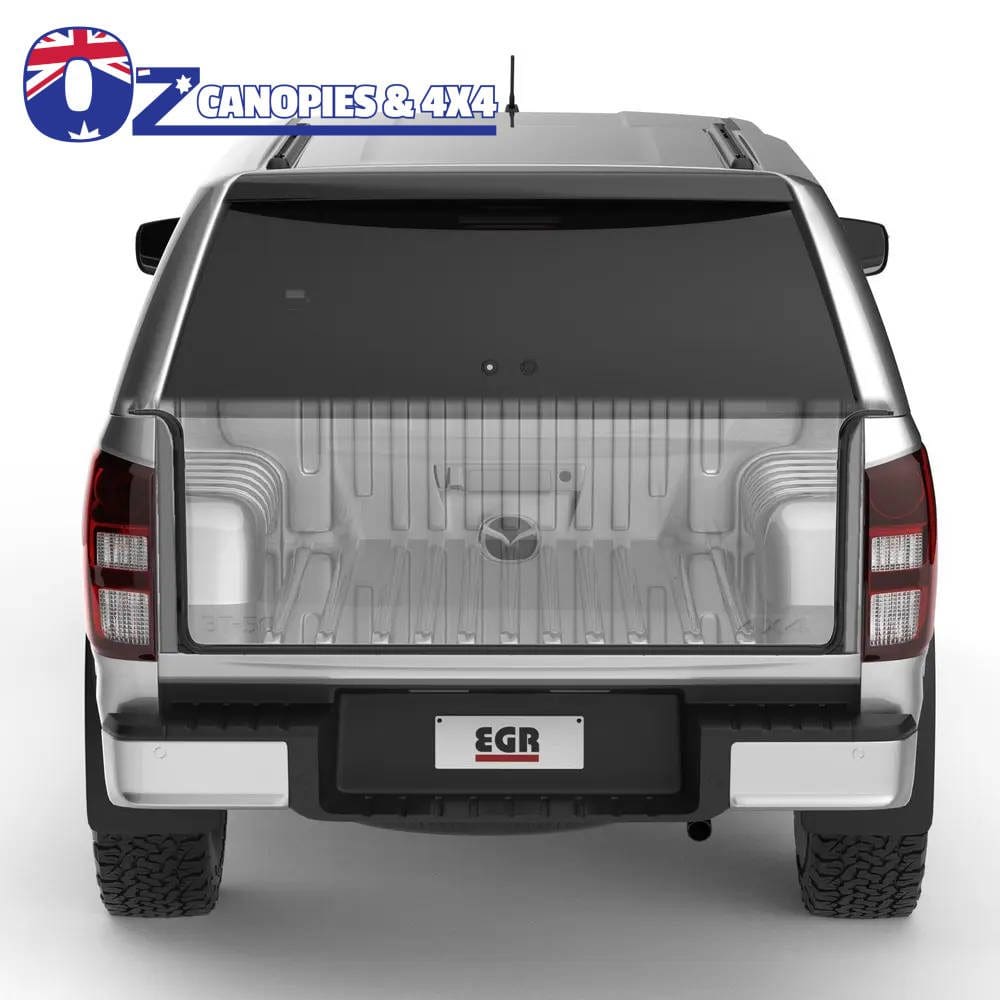
Mazda BT-50 Canopy Comparison: Aluminium vs Steel vs Fibreglass
Most BT-50 owners start shopping for a canopy by looking at photos. What colour does it come in? Does it look good on a BT-50? How much does it cost?
Those things matter. But they’re not what separates a canopy you love from one you regret twelve months later.
The real difference between canopy materials shows up in payload, roof load capacity, durability on rough roads, how hot it gets inside on a 38 degree day and whether it can handle the accessories you want to bolt onto it. Pick the wrong material and you’ll either run out of payload before your build is finished, end up with cracked panels after a season of corrugations or spend more than you needed to.
There’s no single “best” canopy material. The right one depends on whether you’re a sparky hauling tools five days a week, a family heading bush on weekends or someone trying to do both without blowing the weight budget. This guide breaks down aluminium, steel and fibreglass canopies side by side, specifically for the Mazda BT-50, so you can match the material to how you actually use the ute.
If you’re still in the early stages of planning your setup, the full Mazda BT-50 canopy setup guide covers everything from payload maths to 12V wiring and build recipes.
Quick answer: which canopy material is best for most BT-50 owners?
If you just want the short version, here it is:
Best for payload and all round versatility: Aluminium. It’s the lightest of the three, which gives you more room in your weight budget for drawers, dual batteries, fridges and gear. Most aluminium canopies also offer strong roof load ratings when properly engineered. For the majority of BT-50 owners doing a mix of work and play, aluminium is the safest choice.
Best for heavy duty work abuse: Steel. If your canopy lives on construction sites, mining camps or anywhere things get thrown around, steel handles impacts and abuse better than any other material. The trade off is more weight on the rear axle.
Best for factory style finish and comfort: Fibreglass. Nothing matches your vehicle’s paintwork like a colour coded fibreglass canopy. It looks factory fitted, often feels more insulated than bare metal and suits owners who prioritise aesthetics alongside protection.
That said, the “best” material for your BT-50 depends on a few things you’ll need to think through: what you’re putting on the roof, how tight your payload is, whether you’re towing and whether the canopy needs to survive worksites or just weekend camping. The rest of this article digs into those trade offs one by one.
Why canopy material matters more on a BT-50 than people think
The canopy is the foundation of your entire build. Every other accessory, from drawers to dual batteries to roof racks, sits on top of it. And every kilo the canopy weighs is a kilo less you have for everything else.
On a BT-50 4×4 dual cab, you’re typically working with around 900 to 1,100kg of payload depending on your variant and trim level. That sounds generous until you start adding things up. A canopy, drawer system, fridge, dual battery, bull bar, towbar, two adults and a weekend’s worth of gear can eat 600kg+ before you’ve loaded a single tool or piece of camping equipment.
The canopy material determines how much of that payload budget gets used up before the build even starts. The difference between a 55kg aluminium canopy and a 100kg fibreglass canopy is 45kg. That’s an extra 40 litre water tank or a full recovery kit or the margin that keeps you legal at a roadside weight check.
Material also determines what you can put on the roof. If you’re planning a rooftop tent, awning and solar panel, you need a canopy with a high dynamic roof load rating and that’s heavily influenced by the material and internal bracing.
And it affects long term ownership. How does it handle salt air at the coast? What happens when a branch scrapes across it on a bush track? How easy is it to repair a dent or crack? These aren’t problems you think about on day one, but they matter at year three and beyond. Any modification that changes vehicle weight ratings needs to comply with the Department of Infrastructure’s vehicle standards framework, so picking the right canopy weight from the start avoids compliance headaches later.
Common mistake: Treating canopy choice as a cosmetic decision. The material you pick affects payload, roof load, durability, heat, comfort and what accessories you can realistically fit. It’s a build decision, not a style decision.
The three canopy materials explained in plain English
Before we compare them head to head, here’s a quick rundown of what each material actually is and how it’s used in ute canopies.
What is an aluminium canopy?
An aluminium canopy is built from sheet aluminium (usually 2mm to 3mm thick) welded or riveted into a frame structure. Most quality aluminium canopies use 5000 or 6000 series aluminium alloy, which provides a good balance of strength, light weight and corrosion resistance. They’re typically finished with a powder coated surface in standard colours like black, white or silver.
Aluminium canopies range from basic flat panel designs to heavily engineered units with internal gussets, welded cross ribs and reinforced roof structures. The engineering behind the canopy matters as much as the raw material, which is why two aluminium canopies can have very different weight and roof load specs.
What is a steel canopy?
When people say “steel canopy,” they usually mean a canopy made from mild steel sheet (typically 1.2mm to 1.5mm thick) that’s been powder coated or e coated for corrosion protection. Some premium options use stainless steel or a stainless/alloy hybrid construction for better rust resistance.
Steel canopies are inherently heavier than aluminium because steel is a denser material. But they’re also generally tougher against point impacts, which is why they’re popular in trades and commercial fleet applications where the canopy takes a beating.
What is a fibreglass canopy?
Fibreglass canopies are moulded from glass reinforced plastic (GRP), sometimes called fibreglass composite. The shell is formed in a mould and finished with a gel coat or automotive two pack paint, which allows the canopy to be colour matched to your vehicle’s exact paint code.
Fibreglass canopies are typically one piece or two piece moulded shells. They offer a smooth, sleek appearance that looks factory fitted. The construction method means they’re shaped to closely follow the contours of the vehicle’s tub, which is why they generally look more integrated than flat panel metal canopies.
Common mistake: Assuming all fibreglass canopies are lighter than metal ones. Some fibreglass canopies weigh 80 to 100kg, which puts them right in the range of many steel options. Always check the actual weight spec for the specific canopy you’re looking at.
Aluminium vs steel vs fibreglass: head to head comparison
This is the core of the comparison. Each section compares all three materials directly, so you can see the trade offs that matter for your BT-50 build.
Weight and payload
This is the single most important comparison for most BT-50 owners.
Aluminium is the clear winner on weight. Most aluminium canopies for the current BT-50 weigh between 50kg and 80kg. Well engineered premium aluminium units can sit at the lower end of that range while still offering serious roof load capacity. Some lightweight aluminium canopies designed for touring come in under 60kg.
Steel canopies are heavier. Expect 70kg to 110kg+ depending on the design, wall thickness and features. The Oz Canopies heavy duty steel canopy is at the lighter end for a steel unit, but it’s still heavier than most aluminium options.
Fibreglass canopies often surprise people. A one piece moulded fibreglass canopy with glass windows can weigh anywhere from 60kg to 100kg. Some hand laid fibreglass canopies with full glass lift up windows sit around 80 to 100kg, which is heavier than many aluminium options and comparable to some steel canopies.
Why this matters on a BT-50: A BT-50 4×4 dual cab XTR has roughly 1,070kg of payload. Every kilo the canopy weighs comes directly off that figure. If you’re planning a touring build with drawers (40 to 65kg), fridge setup (35 to 50kg), dual battery (25 to 40kg) and a roof rack with gear, choosing a 55kg aluminium canopy over a 95kg fibreglass canopy gives you an extra 40kg for actual cargo. That adds up fast.
For owners considering a GVM upgrade down the track, starting with a lighter canopy can delay or even eliminate the need for one. Keep in mind that your vehicle’s GVM is set under the Australian Design Rules (ADRs) and exceeding it has legal, insurance and safety consequences.
Strength, durability and impact resistance
This is where the comparison gets more nuanced than “steel is strongest.”
Steel handles blunt impacts well. If something heavy hits the canopy on a worksite, steel dents rather than cracking. Dents in steel are cosmetically annoying but don’t usually compromise structural integrity. For tradies working on construction sites, demolition jobs or anywhere things get thrown into and onto the canopy, steel is the most forgiving material.
Aluminium is strong, but it behaves differently under impact. Aluminium tends to deform more permanently than steel on a sharp impact. A dent in aluminium is harder to push back out without specialist tools. However, well engineered aluminium canopies with internal ribbing and gussets are extremely rigid overall. The frame structure carries the load, not just the skin panels. On corrugated roads and off road tracks, a properly braced aluminium canopy handles the dynamic forces very well.
Fibreglass is rigid but brittle compared to metals. It handles distributed loads (like roof weight) reasonably well but is vulnerable to point impacts. A rock thrown up by a tyre, a tree branch scraping across the panel or dropping something heavy onto the canopy can crack or chip fibreglass where metal would just dent. Cracks can spread if not repaired and in severe cases, the structural integrity of the panel is compromised.
The honest truth: No canopy material is indestructible. Steel dents, aluminium dents, fibreglass cracks. The question is which failure mode matters less for how you use the ute. For worksite abuse, denting beats cracking. For touring and lifestyle use, none of them should be taking impacts severe enough to matter.
Roof load and accessory mounting
Roof load capacity is one of the top three reasons people choose one canopy over another. If you’re planning a roof rack, rooftop tent, awning or solar panel, this section matters.
The key point: Roof load capacity is determined by canopy engineering more than raw material. A well braced aluminium canopy can easily outperform a poorly designed steel canopy on roof load. What matters is internal ribbing, cross bracing, gusset reinforcement and the quality of the roof rail system.
That said, here’s how the materials generally compare:
Steel canopies often have the highest roof load ratings because the material’s inherent rigidity allows for strong roof structures even with simpler internal bracing. The Oz Canopies steel canopy for the BT-50, for example, is rated at 200kg dynamic and 300kg static. That comfortably supports a roof rack, rooftop tent, awning and solar panel.
Aluminium canopies with proper internal bracing offer comparable roof load ratings. Premium aluminium units with engineered cross ribs and M8 roof rail channels can achieve 200 to 250kg dynamic ratings, which is more than enough for a full touring setup. Budget aluminium canopies with minimal internal bracing may only be rated at 80 to 100kg dynamic, which limits what you can safely carry on the roof.
Fibreglass canopies typically have lower roof load ratings. Many fibreglass canopies are rated at 80 to 100kg dynamic with standard roof rails. Some trade oriented fibreglass canopies with internal crossbar reinforcement can reach 150 to 160kg. But for heavy rooftop tent and awning setups, fibreglass is generally the weakest option unless specifically engineered for it.
Dynamic vs static: Remember, dynamic is what the roof handles while driving. Static is what it handles when parked. A rooftop tent weighs 50 to 80kg folded (dynamic when driving) but supports 150+ kg of occupants when deployed (static when parked). Your canopy needs to handle both. The NTC Load Restraint Guide reminds us that loads need to be secured against the forces of acceleration, braking and cornering, not just dead weight.
Common mistake: Assuming the roof load rating of a cheap canopy is the same as a premium one just because they’re both made from the same material. Construction quality and internal bracing make more difference than material alone.
Heat, insulation and comfort
If you’ve ever opened a bare metal canopy after it’s been sitting in the sun for three hours, you know what this section is about.
Steel and aluminium canopies both absorb and radiate heat effectively. On a hot day, an uninsulated metal canopy turns into an oven. The interior temperature can exceed 60 degrees Celsius in direct sun. This matters if you’re storing temperature sensitive items (electronics, medications, food), keeping a fridge cool (it has to work harder, draining more battery) or sleeping in the canopy (not pleasant without ventilation and insulation).
Fibreglass generally feels less extreme in terms of heat transfer. The composite material doesn’t conduct heat as efficiently as metal, so the interior temperature is typically a few degrees lower in direct sun. It’s not a dramatic difference, but it’s noticeable. Fibreglass canopies also tend to feel less condensation prone overnight because the interior surface doesn’t cool as rapidly as metal.
The practical fix for all three: Internal insulation (closed cell foam or automotive sound deadener), carpet lining and adequate ventilation (positive pressure vents, sliding windows) make a far bigger difference to internal comfort than the raw material. A well insulated aluminium canopy with good ventilation will be more comfortable than an unlined fibreglass canopy with no vents.
For owners who travel with dogs, carry temperature sensitive gear or plan to sleep in the canopy, investing in insulation and ventilation upgrades is worth more than choosing one material over another purely for heat reasons.
Corrosion, weather exposure and long term ownership
Corrosion is the quiet killer of canopy longevity, especially in Australia where salt air, beach driving and unpredictable weather are part of the deal.
Aluminium has excellent natural corrosion resistance. It forms a thin oxide layer that protects the underlying metal. In coastal environments, near salt water or on vehicles that regularly drive on beaches, aluminium holds up very well. Powder coated aluminium adds another layer of protection. It’s not immune to corrosion (galvanic corrosion can occur where aluminium contacts dissimilar metals without proper insulation), but it’s the most corrosion resistant metal option.
Steel is the most vulnerable to rust. If the powder coating or e coat gets chipped, scratched or damaged, bare steel is exposed to moisture and will rust. This is a real concern for vehicles driven on beaches, in coastal areas or on construction sites where flying debris chips the finish. Quality powder coating and e coating (electrophoretic deposition) provide good protection, but they need to be maintained. Chips and scratches should be touched up promptly.
Fibreglass doesn’t rust. Full stop. That’s one of its genuine advantages. However, fibreglass has its own ageing issues. The gel coat finish can fade and chalk over time with UV exposure. The resin can become brittle after years of sun, heat and vibration, making older panels more susceptible to cracking. And any cracks that do form can allow water ingress into the fibreglass layup, which degrades the material from the inside out if not repaired.
For BT-50 owners near the coast or who regularly drive on sand: Aluminium is the safest long term bet for corrosion resistance. Steel needs diligent maintenance. Fibreglass won’t rust but needs UV protection and prompt crack repair.
Security
For tradies especially, a canopy is a security system as much as a weather cover. Tool theft costs Australian trades millions every year and a canopy that’s easy to break into isn’t doing its job. On the safety side, a properly secured canopy also means loose items don’t become projectiles in a crash, something ANCAP testing reinforces as critical for occupant safety.
Security is mostly about the locking system and frame design, not just the material. Central locking that integrates with the vehicle’s remote, heavy duty compression locks, reinforced door frames and anti tamper hardware all matter more than whether the panels are made of aluminium, steel or fibreglass.
That said, there are some material level differences:
Steel canopies are generally harder to force open due to the material’s resistance to bending. A steel door frame is difficult to pry without serious tools.
Aluminium canopies with quality locks and reinforced frames offer comparable security. The material is softer than steel, so thinner aluminium panels could theoretically be forced more easily. But a well designed aluminium canopy with proper locking isn’t significantly less secure than steel in practice.
Fibreglass can be broken through with a sharp impact more easily than metal. A determined thief with a hammer can crack a fibreglass panel. For tradies in high theft areas, this is worth considering. Fibreglass canopies tend to suit lifestyle and touring applications where security requirements are lower.
Repairs and maintenance
Every canopy material will eventually need maintenance or repair. The question is what that looks like and what it costs.
Steel is the easiest to repair in most workshops. Dents can be pushed or pulled out. Welding steel is straightforward for most fabricators. A damaged panel can be cut out and replaced. The downside is that any repair that breaks the protective coating exposes bare steel, which needs to be re primed, re painted or re coated to prevent rust.
Aluminium repair is more specialist. Aluminium welding requires TIG welding with argon gas, which not every workshop can do. Dent removal is possible but aluminium has less “memory” than steel, so dents don’t always pop back cleanly. That said, aluminium’s corrosion resistance means repairs are less urgent, since exposed aluminium doesn’t rust the way steel does.
Fibreglass repair is a different process entirely. Cracks and holes are repaired with fibreglass mat, resin and filler, then sanded and repainted. It’s not difficult (many panel shops can do it), but colour matching a repaired area to the rest of the canopy can be tricky. Major structural damage to fibreglass is harder and more expensive to fix properly compared to welding a new steel panel.
Maintenance wise: Steel needs the most ongoing attention (touch up chips, check for rust). Aluminium needs the least (wash it, check seals, done). Fibreglass sits in the middle (check for cracks, maintain the gel coat, replace seals).
Price and value over time
Let’s talk money. These are broad indicative ranges for a BT-50 canopy, not specific brand pricing, because options, features and installation costs vary significantly.
Aluminium canopies for the BT-50 typically range from around $2,000 for a basic flat panel design up to $5,000+ for a premium engineered unit with gas strut gullwing doors, high roof load rating, central locking and positive pressure ventilation.
Steel canopies sit in a similar range. Entry level steel canopies start around $2,500, with heavy duty options with integrated tie down rails, lift up doors and high roof load ratings sitting between $3,000 and $5,500.
Fibreglass canopies tend to start slightly higher, particularly for colour coded options. Expect $2,500 to $4,500+ for a quality fibreglass canopy with colour matching, lift up windows and central locking. Premium fibreglass canopies with full OEM matched paint can push higher.
Value over time: Aluminium generally offers the best long term value because of its corrosion resistance, low maintenance needs and lighter weight (which preserves vehicle payload and reduces wear on suspension and brakes). Steel offers excellent value for tradies who need maximum toughness and roof load and don’t mind the extra maintenance. Fibreglass offers value to owners who prioritise aesthetics and vehicle resale, as a well maintained colour matched fibreglass canopy can enhance the perceived value of the vehicle.
Comparison table: aluminium vs steel vs fibreglass for a BT-50
Here’s the quick reference version. Keep in mind these are general guidelines. Individual canopy models can vary significantly based on engineering and build quality.
| Factor | Aluminium | Steel | Fibreglass |
| Typical weight | 50 to 80kg | 70 to 110kg+ | 60 to 100kg |
| Payload impact | Lowest (best) | Highest | Mid range |
| Roof load potential | High (with bracing) | Highest | Lower (typically) |
| Impact durability | Good (dents permanently) | Excellent (dents, recoverable) | Fair (cracks on impact) |
| Heat / comfort | Hot uninsulated | Hot uninsulated | Slightly better insulated |
| Corrosion resistance | Excellent | Needs maintenance | No rust (UV ageing instead) |
| Security suitability | Good with quality locks | Very good | Fair to good |
| Repairability | Specialist welding | Easy in most workshops | Panel/resin repair |
| Best colour match | Limited standard colours | Limited standard colours | OEM paint match available |
| Best suited for | Touring, hybrid, payload conscious | Heavy duty trade, high roof loads | Lifestyle, aesthetics, resale |
Use this table as a starting point, but always check the specs of the actual canopy you’re considering. A well built aluminium canopy can outperform a cheap steel one on roof load and a poorly made aluminium canopy can be heavier than a decent fibreglass one.
Which canopy material suits your BT-50 build?
Time to get specific. Here’s how each material stacks up against common BT-50 build scenarios.
Best for tradies
Steel or aluminium, depending on your trade.
If you’re working on rough sites where the canopy takes impacts from materials, machinery or daily loading, steel is the more forgiving choice. It handles dents better and typically offers the highest roof load ratings for carrying ladders, pipe or materials on top.
If you’re a sparky, plumber or IT tech whose gear goes inside the canopy rather than on top, aluminium gives you the same security (with good locks) at a lower weight. That means more payload available for heavy tools and test equipment.
Either way, central locking that integrates with the vehicle remote is a non negotiable for any tradie setup. You’ll be opening and closing that canopy 20+ times a day.
Best for touring builds
Aluminium is the go to.
Touring builds are all about weight management. You’re adding drawers, a fridge, dual battery, water, recovery gear, an awning, maybe a rooftop tent. Every kilo matters. Starting with the lightest canopy that still meets your roof load needs gives you the most room for everything else.
A quality aluminium canopy with a 150kg+ dynamic roof load rating, positive pressure vent and gas strut windows is the sweet spot for touring BT-50 builds. It’s light enough to preserve payload, strong enough for a rooftop tent setup and corrosion resistant for beach and bush driving.
Best for mixed use owners
Aluminium, with steel as a close second.
If you’re using the BT-50 for work during the week and bush trips on the weekend, you need a canopy that’s tough enough for daily use but light enough for touring gear. Aluminium handles both roles well.
If your worksite is particularly rough, a steel canopy is worth the extra weight. Just factor it into your payload calculations for weekend trips, especially if you’re adding touring accessories and towing.
Best for owners trying to protect payload
Aluminium, hands down.
If payload is your primary concern and it should be for any BT-50 owner who tows, carries passengers or runs a loaded build, the lightest canopy that meets your functional needs is the right choice. A 55kg aluminium canopy versus a 95kg fibreglass canopy gives you an extra 40kg of usable payload. Over the life of the vehicle, that adds up to thousands of extra kilos of cargo capacity.
Best for owners wanting a factory style look
Fibreglass is the clear winner here.
If you want the canopy to look like it came from the factory, colour coded fibreglass is the only material that delivers a true OEM paint match. It follows the contours of the BT-50’s tub closely, the paint matches the vehicle exactly and the overall look is seamless.
This matters for owners who use the BT-50 as a daily driver and family vehicle, where aesthetics and street presence are part of the decision. It also helps with resale, as a well maintained colour matched canopy adds visual appeal to a vehicle listing.
What we recommend at Oz Canopies & 4×4
We sell both steel and aluminium canopies for the BT-50 and we’ve fitted hundreds of them. Here’s our honest take.
For most BT-50 owners doing a mix of work and play: An aluminium canopy with quality locks, gas strut windows and a decent roof load rating is the smartest all rounder. It keeps your options open for future accessories without eating into payload.
For tradies on rough sites who need maximum toughness and roof load: Our heavy duty steel canopy for the BT-50 (2020+) with 200kg dynamic roof load, lift up doors on all three sides and an integrated tie down rail is built for exactly that. It takes a beating and gives you a solid platform for roof racks and materials.
For any buyer: Start with the payload maths. Figure out your GVM, your kerb weight and how much you’re planning to add. The canopy material should support the build, not limit it. If you’re not sure, send us your variant, planned accessories and use case. We’ll help you work out what makes sense.
With over 350 five star Google reviews, we’ve built a reputation on giving straight advice, not just selling the most expensive option.
Common mistakes BT-50 buyers make when comparing canopy materials
We’ve seen all of these. More than once.
Choosing by looks alone. A colour coded fibreglass canopy looks brilliant on the showroom floor. But if it weighs 95kg and you’re planning a touring build with drawers, fridge, dual battery and rooftop tent, you’ve just used up a chunk of payload on aesthetics. Make sure the material suits the build, not just the look.
Ignoring payload entirely. This is the big one. Plenty of BT-50 owners buy a canopy, bolt on accessories, load up the tub and never check what the vehicle actually weighs. Then they’re surprised when the rear end sags, the handling goes off or they get pulled up at a weigh station. Always do the maths. VSB 14 and your vehicle’s compliance plate exist for a reason.
Assuming all aluminium canopies are light. They’re not. Some budget aluminium canopies are overbuilt with heavy panels and minimal engineering, pushing them to 80kg+. Check the actual weight spec, don’t just assume “aluminium equals light.”
Assuming all steel canopies are stronger. A well engineered aluminium canopy with proper internal bracing can be more rigid than a thin gauge steel canopy with no reinforcement. Material alone doesn’t determine strength. Construction quality does.
Assuming all fibreglass canopies are weak. Trade oriented fibreglass canopies with internal crossbar reinforcement can handle decent roof loads. It’s the basic styleside canopies with thin shells and no reinforcement that struggle under heavy loads.
Not planning for future roof loads. You might not need a roof rack today, but what about in six months when you want an awning? Or a rooftop tent in a year? Choose a canopy with headroom in its roof load rating so you’re not stuck when your needs change.
Buying cheap first, then rebuilding later. The cheapest canopy is rarely the cheapest overall. If you buy a low quality canopy, deal with dust leaks, poor sealing, weak hinges and inadequate roof load, then replace it with a proper one two years later, you’ve paid twice. Buy once, buy right.
So which canopy material should you choose?
Let’s make this simple.
Choose aluminium if you want the lightest option, you’re building a touring or hybrid setup, payload is tight, you want corrosion resistance without fuss or you need a solid platform for a rooftop tent and accessories. It’s the most versatile material for most BT-50 owners.
Choose steel if you need maximum toughness for worksite abuse, you want the highest roof load ratings, you’re not as concerned about weight or you’re running a dedicated trade setup where durability trumps everything else.
Choose fibreglass if you want a factory matched paint finish, aesthetics and resale value are top priorities, you’re using the BT-50 as a lifestyle vehicle and you don’t need heavy roof loads or extreme durability.
For every choice, the underlying principle is the same: match the material to how you use the ute, not to what looks best in a photo.
Ready to compare options? Get in touch with the team at Oz Canopies & 4×4. Tell us your BT-50 variant, how you use it and what you’re planning to put on the roof. We’ll point you to the right canopy and make sure the build adds up, literally.
Call us on 02 9627 8666, text 0440 130 098 or visit our showroom at 20 Walker St, South Windsor.f
FAQs
Which canopy material is lightest for a BT-50?
Aluminium is the lightest option overall, with most BT-50 aluminium canopies weighing between 50kg and 80kg. Well engineered premium aluminium canopies can sit at the lower end of that range while still offering strong roof load capacity. By comparison, steel canopies typically weigh 70 to 110kg and fibreglass can range from 60 to 100kg depending on the design and glass content.
Is a steel canopy too heavy for touring?
Not necessarily, but it does eat into your payload more. A steel canopy weighing 90 to 100kg leaves less room for touring accessories like drawers, fridges, dual batteries, water and recovery gear. If you’re planning a loaded touring build on a BT-50, aluminium gives you more breathing room. If you’re doing lighter touring with fewer accessories, a steel canopy can work fine.
Are fibreglass canopies strong enough for roof racks?
Most fibreglass canopies can handle a basic roof rack with crossbars and moderate loads (80 to 100kg dynamic). For heavier setups like a rooftop tent plus awning plus solar, some fibreglass canopies may not have a high enough roof load rating. Check the specific canopy’s dynamic and static ratings before committing to a heavy roof setup. Trade focused fibreglass canopies with internal crossbar reinforcement handle heavier loads better.
Is aluminium better than steel for rust resistance?
Yes. Aluminium naturally forms a protective oxide layer that resists corrosion, even in salt air and coastal environments. Steel relies entirely on its protective coating (powder coat, e coat, paint) to prevent rust. If that coating gets chipped or scratched, bare steel is exposed and will rust. For BT-50 owners near the coast or who drive on beaches regularly, aluminium is the safer choice for long term corrosion resistance.
Which canopy material is best for tradies?
It depends on the trade. For construction, demolition and heavy site work where the canopy takes impacts, steel is the tougher option. For electrical, plumbing, IT and service trades where tools go inside the canopy rather than on top, aluminium offers the same security (with quality locks) at a lighter weight, leaving more payload for heavy tools and equipment. Either way, central locking is essential for any tradie setup.
Which material stays coolest in summer?
Fibreglass has a slight edge because the composite material doesn’t conduct heat as efficiently as metal. But the difference is modest. An uninsulated canopy of any material will get extremely hot inside on a summer day. The real solution for managing canopy heat is internal insulation (closed cell foam or sound deadener on the roof), carpet lining and proper ventilation with positive pressure vents and opening windows. These upgrades make more difference than material choice alone.
Does canopy material affect resale?
It can. A well maintained colour matched fibreglass canopy can enhance a vehicle’s resale appeal because it looks factory fitted. Aluminium and steel canopies in standard colours (black, white) are functional but don’t add the same visual appeal. That said, a quality canopy of any material in good condition is generally seen as a positive by buyers, especially for work vehicles where a canopy signals a well equipped rig.
What matters more: material or canopy design?
Design and engineering. Two canopies made from the same material can perform very differently based on wall thickness, internal bracing, roof structure, seal quality, locking hardware and vent design. A premium aluminium canopy with engineered cross ribs and quality seals will outperform a cheap steel canopy with thin panels and poor sealing on almost every measure except raw impact toughness. Always look at the complete package, not just the material label.
Quick decision guide: pick your BT-50 canopy material in 60 seconds
Still stuck? Run through this.
Step 1: What’s your primary use?
- Worksite daily (construction, demolition, heavy trade) → lean steel
- Touring, camping, weekends away → lean aluminium
- Mix of both → lean aluminium
- Daily driver, lifestyle, family vehicle → lean fibreglass
Step 2: What’s going on the roof?
- Rooftop tent + awning + solar → you need 150kg+ dynamic. Aluminium or steel.
- Roof rack for ladders or materials → steel handles heavy, awkward loads well.
- Light crossbars or nothing → any material works.
Step 3: How tight is your payload?
- Already planning drawers, fridge, dual battery, bull bar, towbar → go as light as possible. Aluminium.
- Light setup with minimal accessories → weight matters less. Choose on other factors.
- Towing regularly → every kilo counts. Aluminium saves payload for towball download.
Step 4: Does colour match matter?
- Must match the vehicle’s paint → fibreglass is the only true OEM colour match.
- Standard black or white is fine → aluminium or steel in powder coat.
If you answered “aluminium” to most of those, you’re in good company. It’s the most popular choice for BT-50 builds for a reason. But there’s no wrong answer if the material matches how you actually use the ute.
Need a hand narrowing it down? Send us your BT-50 variant, what you’re planning for the roof and how you use the ute. We’ll tell you which canopy makes sense and make sure the weight stacks up before you spend a cent.
Call us on 02 9627 8666, text 0440 130 098 or visit the Oz Canopies & 4×4 showroom at 20 Walker St, South Windsor. No pressure, just honest advice from people who do this every day.
